Wireless networks used to be designed like carefully engineered machines. Researchers built mathematical models, optimized formulas, and deployed protocols that worked under expected conditions. This model-driven approach has been remarkably successful, giving us generations of faster and more reliable communication systems.
But 6G is pushing wireless networks into a much more complex world.
Future networks will operate across millimeter-wave, terahertz, near-field, cell-free, non-terrestrial, and reconfigurable environments. They will serve vehicles, robots, drones, sensors, extended-reality devices, smart factories, digital twins, and human-centered applications. They will need to sense the environment, predict blockage, align narrow beams, protect users, manage resources, and explain their decisions.
In such a world, artificial intelligence is not just an add-on. It becomes part of the network’s nervous system.
This is the idea behind AI-native wireless networks: communication systems designed from the ground up to learn from data, reason about context, adapt to change, and operate with trustworthy autonomy.
From AI-assisted to AI-native
Many wireless systems already use AI in isolated tasks: predicting traffic, allocating resources, estimating channels, or selecting beams. But AI-native wireless networks go further. They do not simply attach a neural network to an existing protocol. They integrate learning, sensing, reasoning, and control into the communication loop itself.
In this vision, the network continuously asks: What is happening around me? Which users are moving? Where is blockage likely? Which beam should I use? Is my AI model confident? Can I explain this decision? Can I adapt with limited real-world data?
My AI-native wireless research starts from a broad question: how can generative AI, explainable AI, digital twins, multimodal sensing, and agentic intelligence reshape the design of 6G networks?
The tutorial-survey on generative AI for 6G wireless intelligence framed this landscape. It showed how generative models can support physical-layer design, network optimization, traffic analytics, security, localization, semantic communication, integrated sensing and communication, terahertz networks, near-field communication, digital twins, edge AI, and trustworthy AI [1].
The key insight is that wireless data is often scarce, costly, incomplete, and environment-specific. Generative AI can help by learning the structure of wireless environments and generating useful representations, synthetic data, or channel parameters when direct measurements are limited.
ENWAR: environment-aware wireless reasoning with multimodal LLMs
A major limitation of today’s wireless systems is that they often react to signal measurements without understanding the physical scene behind them. A base station may observe that a link is weak, but it may not know whether the cause is a vehicle blockage, sensor degradation, a changing line-of-sight condition, or an upcoming handover.
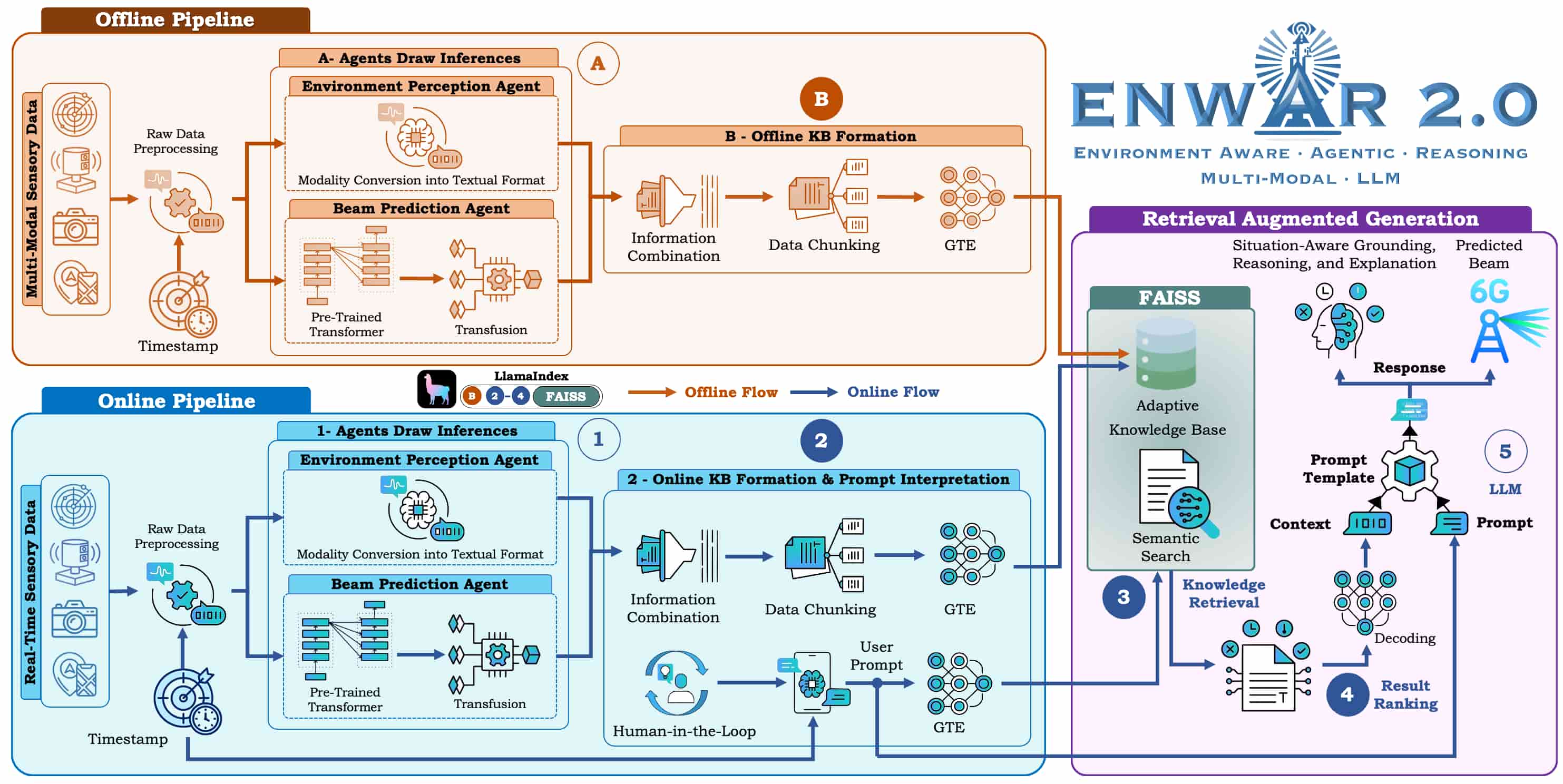
The ENWAR research line addresses this gap by bringing multimodal sensing, retrieval-augmented generation, and agentic large language models into wireless network intelligence.
ENWAR 1.0 introduced an environment-aware RAG-empowered multimodal LLM framework for wireless environment perception. It integrates sensory inputs such as GPS, LiDAR, and camera data to interpret dynamic wireless scenes. Compared with generic LLM responses, ENWAR provides richer spatial analysis: it can identify positions, reason about obstacles, assess line-of-sight conditions, and produce human-interpretable situational awareness for vehicular networks [2].
ENWAR 2.0 extends this idea into an agentic framework. It introduces specialized agents for environment perception and beam prediction, fusing camera, LiDAR, radar, and GPS inputs. The system supports target-in-the-loop beam tracking and situation-aware explanations, so it does not merely predict a beam; it also explains the surrounding context behind the decision. This turns wireless beam management into a reasoning problem rather than a pure classification task [3].
ENWAR 3.0 takes the next step toward real-time, adaptive wireless orchestration. It unifies multimodal sensing, agentic LLMs, and context-driven model selection for predictive beamforming, blockage detection, and handover management. A sensor-health classifier detects degradation across camera, radar, LiDAR, and GPS inputs, while a primed LLM coordinates specialized agents through structured, task-aware prompting. By dynamically selecting sensor-specific models based on environmental context, ENWAR 3.0 supports robust operation even when some sensory inputs degrade. The framework reports beam-selection accuracy above 88%, blockage F1-scores above 98%, and reasoning correctness of 87% on complex decision prompts [4].
Across these three versions, ENWAR shows how AI-native wireless networks can evolve from signal-driven optimization toward environment-aware reasoning. The network does not only ask, “Which beam is best?” It asks, “What is happening around me, which sensors can I trust, what will happen next, and which wireless action should I take?”
Explainable and robust AI: making wireless intelligence trustworthy
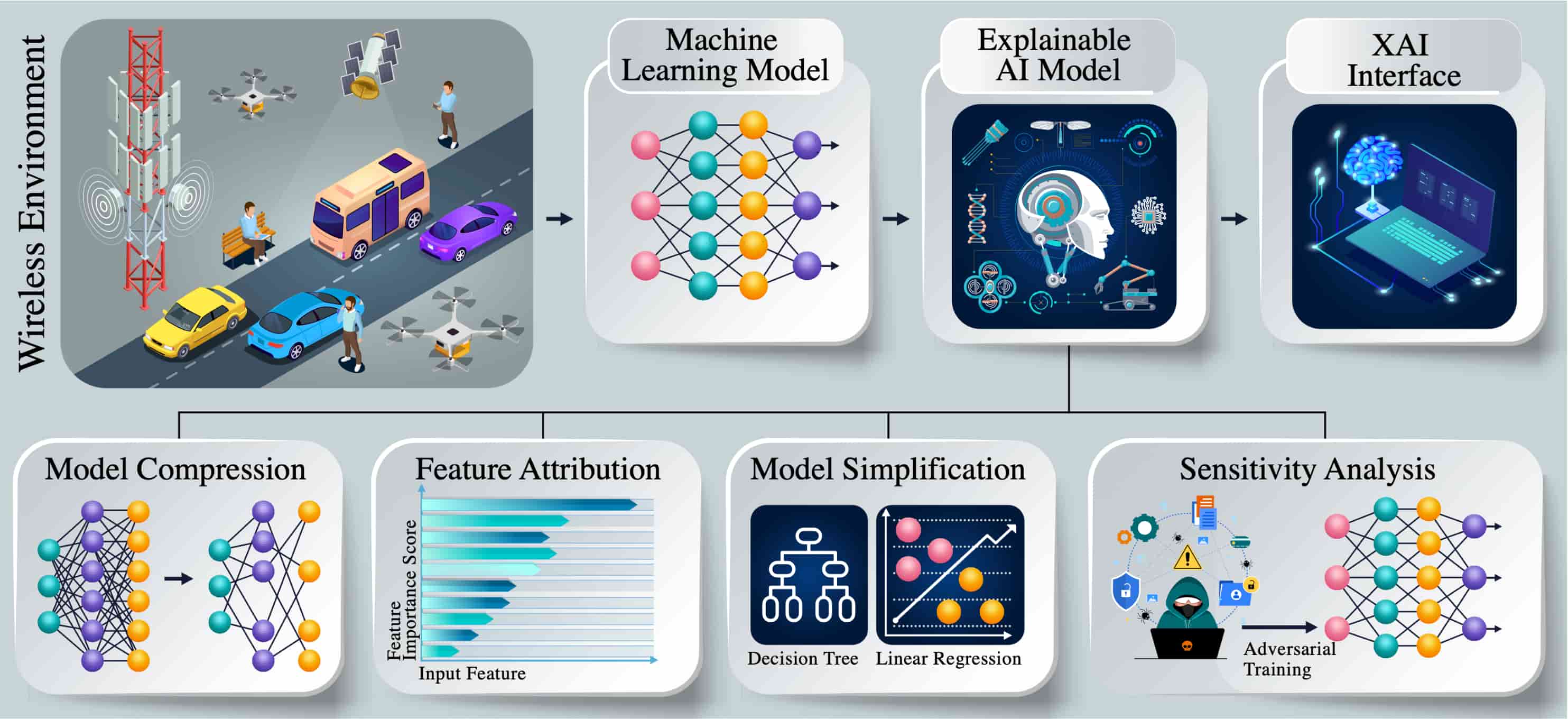
AI-native wireless networks cannot rely on black-box predictions alone. A beam-selection model may choose the right beam most of the time, but engineers still need to know when the model is uncertain, why a decision was made, whether the input is unfamiliar, and how the system behaves under changing conditions.
This is the focus of our explainable and robust AI research for 6G networks. The central idea is that AI should not only improve performance; it should also become inspectable, reliable, and trustworthy enough for real wireless deployments [5].
In one line of work, we developed explainable and robust beam-alignment methods for millimeter-wave MIMO systems. Instead of exhaustively sweeping many narrow beams, the model uses received signal strength measurements from a small set of probing beams to predict the best communication beam. To make this process more transparent, explainable AI tools help identify which input measurements drive the decision, while robustness checks help detect out-of-distribution or unreliable predictions [6], [7].
This idea was extended through digital twins. A wireless digital twin can generate realistic site-specific training data before full deployment, reducing the amount of costly real-world measurement needed. By combining digital-twin data, transfer learning, and explainable AI, the network can learn beam-alignment strategies that are both data-efficient and more interpretable [6].
A related causal beam-selection study asks an even deeper question: which measurements actually matter for the beam decision? By identifying causal features instead of relying on every available input, the system can reduce beam-sweeping overhead and input-selection complexity while preserving reliable initial access [8].
Together, these works frame trustworthy AI as a core requirement for 6G. Accuracy is only the beginning. AI-native wireless systems must also know when to trust themselves, when to ask for more information, and how to explain their decisions to human operators [5].
Digital twins: training networks before deployment
Real wireless measurements are expensive. Collecting enough data for every street, building, factory, or room is often impractical. A digital twin offers a way forward.
A wireless digital twin is a virtual replica of a real environment, often built using ray tracing, measurement calibration, and geometry-aware simulation. It can generate realistic signal data before the physical network is fully deployed.
In RIS-aided wireless systems, our lab-to-digital-twin work calibrates millimeter-wave ray tracing using experimental measurements. The resulting digital twin closely matches measured received-signal-strength data in single-RIS, cascaded-RIS, and RIS-partitioning setups [9].
Digital twins are important because they provide a safe training ground. Before an AI-native wireless system makes decisions in the real world, it can learn inside a realistic virtual copy of that world.
Generative AI for channel estimation
Channel estimation is one of the most fundamental tasks in wireless communication. The network must understand how signals travel from transmitter to receiver before it can beamform, allocate resources, or control interference.
But in millimeter-wave massive MIMO systems, channel estimation is difficult. Channels are high-dimensional, received signals can be weak, and hybrid beamforming limits the number of radio-frequency chains. Traditional compressive-sensing methods can be accurate but computationally heavy.
Our classifiers-guided conditional GAN framework approaches the problem differently. Instead of recovering every channel component through iterative search, the model uses user and base-station locations to generate angular-domain channel parameters. It predicts line-of-sight status, estimates the number of paths, and synthesizes angle-of-arrival and angle-of-departure values using conditional generative adversarial networks. These generated parameters define sparse channel support and enable lightweight channel reconstruction [10].
The larger message is that generative AI can do more than produce text or images. In wireless networks, it can generate physically meaningful channel structure.
Reinforcement learning for programmable wireless environments
AI-native wireless becomes even more powerful when the environment itself is programmable. Reconfigurable intelligent surfaces, or RISs, can reshape wireless propagation, but controlling them is difficult because they contain many passive elements and often lack direct channel sensing. This is a natural setting for reinforcement learning.
In our multi-agent deep reinforcement learning work for RIS-aided systems, agents learn beamforming and RIS reflection codebooks using received signal strength feedback rather than full channel state information. This reduces the need for expensive channel acquisition and dramatically lowers beam-training overhead [11].
The same idea extends to distributed RIS networks and RIS-aided cell-free massive MIMO. Instead of one base station and one surface, the network may include multiple access points and multiple RISs. Multi-agent DRL can coordinate beamforming and reflection decisions across this distributed system, reducing overhead and improving coverage and energy efficiency [12], [13].
A related experimental work combines multimodal sensing and DRL for RIS-aided millimeter-wave massive MIMO. A stereo camera mounted on the RIS detects users, while inertial sensors provide 3D coordinates. DRL agents then optimize RIS phase shifts and user beamformers without explicit channel-state acquisition. The testbed results show near-optimal sum-rate performance while reducing computational complexity [14].
This is AI-native wireless in a very concrete form: the network senses the environment, learns the right beam, and programs the propagation medium.
AI for energy-aware aerial networks
AI-native design is not limited to terrestrial base stations. UAV-assisted IoT networks also need intelligent adaptation because aerial platforms must balance data collection, coverage fairness, movement, and energy consumption.
In our energy-efficient UAV trajectory optimization work, reinforcement learning helps a UAV adapt its path in response to dynamic network conditions while accounting for solar energy, charging stations, data rate, energy consumption, and fairness among IoT terminals [15].
This work connects AI-native wireless to non-terrestrial networks. A flying base station cannot rely only on static planning. It must learn where to move, when to serve, when to conserve energy, and how to avoid outage.
AI-designed transceivers
AI-native wireless also reaches the hardware and physical-layer signal-design level. Instead of separately designing each block of a transmitter and receiver by hand, autoencoders can learn end-to-end communication strategies.
In our HBC work, autoencoder-based transceivers are trained with CGAN-based channel models to support robust and efficient human body communication. The CGAN learns from real body-channel measurements and generates realistic synthetic channels. The autoencoder then learns encoding and decoding strategies that remain robust to channel variation [16].
Although this example comes from Internet-of-Bodies communication rather than 6G cellular infrastructure, the philosophy is the same: the communication system learns how to communicate over a difficult channel instead of relying entirely on handcrafted assumptions.
Toward self-aware 6G
AI-native wireless networks represent a shift in how we think about communication infrastructure.
The network is no longer just a collection of antennas, switches, protocols, and optimization problems. It becomes a learning system. It can perceive its environment, generate missing knowledge, train inside digital twins, predict beams, explain decisions, program surfaces, coordinate agents, and adapt to mobility and blockage.
My AI-native wireless research connects these layers: generative AI surveys, ENWAR’s environment-aware LLM reasoning, explainable and robust AI, digital twins, causal beam selection, generative channel estimation, reinforcement learning for RIS and cell-free networks, UAV trajectory learning, and autoencoder-based transceivers.
The long-term vision is a self-aware 6G network: one that does not only transmit bits, but understands the world through which those bits travel.