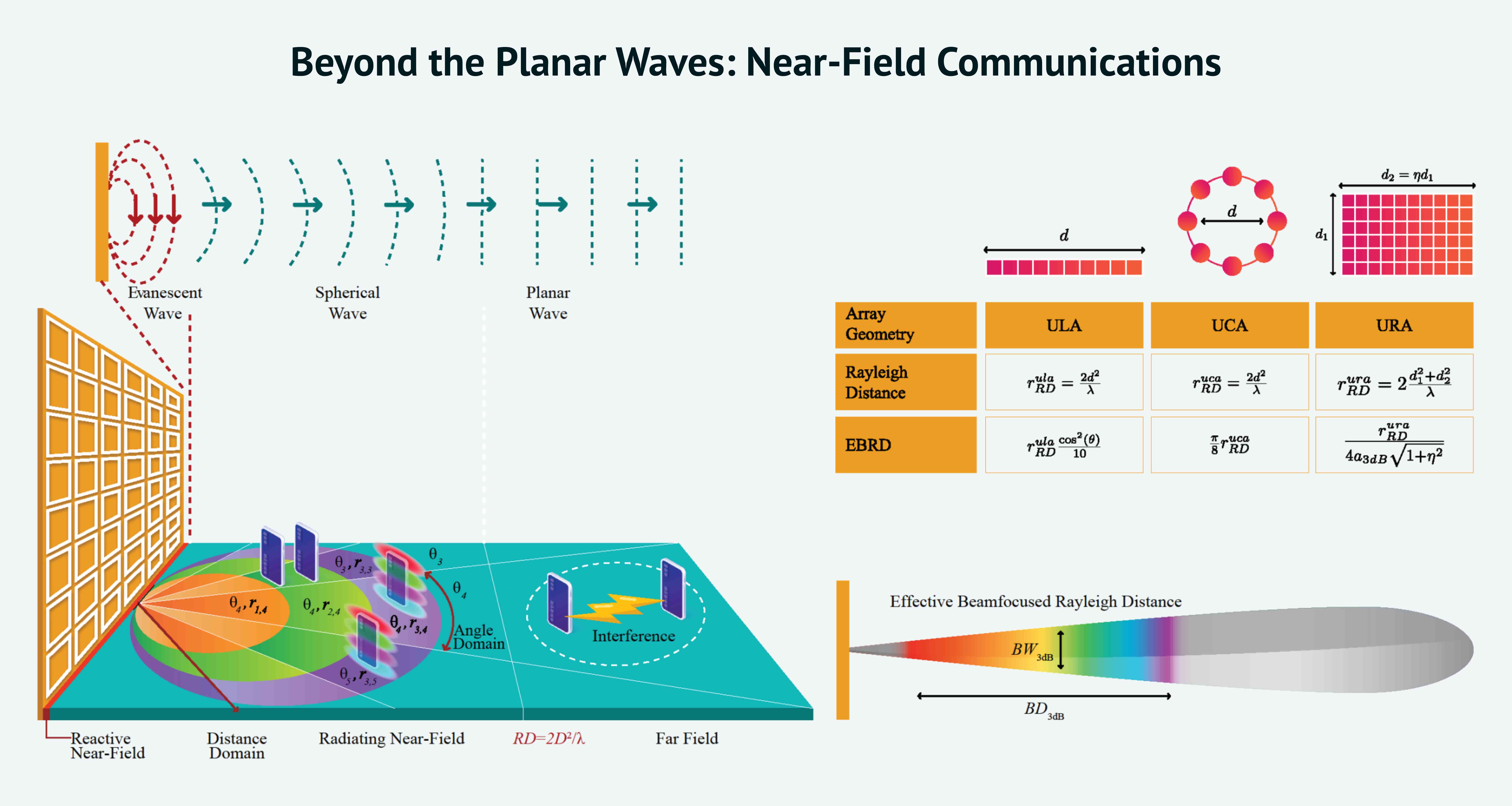
For decades, wireless communication has mostly been designed around a simple mental picture: a base station sends a beam in a direction, and a user receives it. In this traditional “far-field” view, the wavefronts are almost flat by the time they reach the receiver, so the system mainly needs to know where the user is in angle.
But 6G is changing that picture.
Future wireless networks will use extremely large antenna arrays, millimeter-wave and terahertz frequencies, and perhaps even holographic surfaces. These technologies can pack thousands of antenna elements into compact infrastructure. As arrays become larger and wavelengths become smaller, many users will no longer sit in the conventional far-field. They will fall into the radiative near-field, where wavefronts are spherical rather than flat.
That changes everything. The wireless system no longer asks only, “In which direction is the user?” It must also ask, “How far away is the user?”
This is the heart of near-field communication: wireless beams become spatially precise not only in angle, but also in range.
From beam steering to beam focusing
In today’s high-frequency wireless systems, beamforming often means steering energy toward a direction. Near-field communication makes the problem richer. Instead of merely steering a beam, the array can focus energy on a region in space.
A useful analogy is the difference between a flashlight and a camera lens. A flashlight points light in a direction; a lens can focus it at a particular depth. Near-field wireless arrays bring a similar idea to radio waves. They can concentrate signal energy around a spatial location with both an angle and a distance.
This unlocks a new dimension for wireless networks. Users that appear in the same direction but at different distances may become separable. In line-of-sight environments, near-field MIMO can create additional spatial degrees of freedom, almost as if a clean line-of-sight channel begins to behave more like a rich scattering environment [5].
That is why near-field communication is not just a minor correction to existing beamforming. It is a new operating regime.
The codebook problem: how do we search in 3D?
The promise of near-field communication comes with a practical challenge: beam training becomes harder.
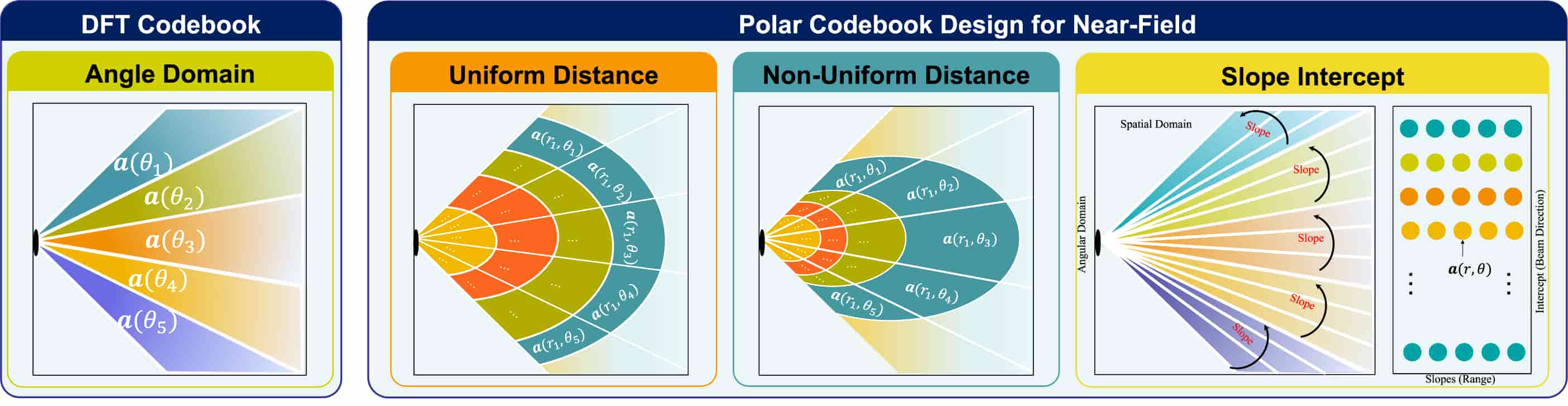
In far-field systems, beam search mainly scans angles. In near-field systems, the search space expands into both angle and distance. A naive search over all possible angles and ranges can create heavy pilot overhead and slow initial access. That is a serious problem for 6G systems that must be fast, adaptive, and efficient.
Our work on polar-domain codebooks addresses this challenge. Instead of using conventional angular codebooks alone, polar-domain codebooks are built around the spherical-wave nature of near-field propagation. They provide structured candidate beams that can probe the channel and focus energy efficiently without requiring exhaustive angle–range search [1].
The main message is simple: near-field systems need near-field codebooks. If the physics changes from planar waves to spherical waves, the mathematical tools used to train and estimate channels must change as well.
Can far-field codebooks still help?
A natural question follows: if near-field codebooks are needed, should we discard all far-field beamforming tools?
Not necessarily.
In our work on near-field beam prediction using far-field codebooks, we studied a surprising possibility: conventional DFT-based far-field beams can still provide useful information in near-field environments. Although a far-field beam is not perfectly focused in range, it produces an angular spread whose structure depends on the user’s range and angle. By exploiting that spread, our correlation interferometry algorithm estimates both angle and distance while significantly reducing training overhead [3].
The result is important because practical systems rarely change overnight. If existing far-field codebooks can be reused intelligently, the transition toward near-field communication becomes more feasible. In this work, the proposed method achieved performance close to exhaustive search while reducing beam-training overhead by 87.5% [3].
Array geometry matters
Near-field communication also revives a fundamental hardware question: what should the antenna array look like?
In far-field systems, array geometry matters, but near-field beam focusing makes geometry even more consequential. The shape of the array influences how sharply a beam can be focused, how deep the focal region is, and how many users can be separated in space.
Our work on uniform rectangular arrays introduced the concept of effective beamfocusing Rayleigh distance, or EBRD, to define the region where near-field beam focusing and spatial multiplexing gains are truly effective. The results show that array geometry can strongly influence beamdepth and spatial degrees of freedom. Under a fixed number of antenna elements, elongated arrays such as uniform linear arrays can provide narrower beamdepth and extend the effective near-field region compared with square arrays [5].
A related PIMRC study showed that a wide or tall rectangular array can achieve a multiuser sum rate 3.5× higher than that of a square array in the considered setting, because the square array’s narrow beamdepth may come with a restricted effective near-field region [4].
The intuition is that “bigger” is not the only design principle. Shape matters. In near-field systems, the array is not merely a collection of antennas; it is a spatial focusing instrument.
Circular arrays: wider view, limited capacity
Uniform circular arrays offer another appealing property: broader angular coverage. If future networks need to serve users around an access point, circular arrays may seem attractive.
Our work on uniform circular arrays in the near-field asks whether this wider angular coverage translates into better spatial multiplexing. The answer is nuanced. Circular arrays can improve angular coverage, but under a fixed antenna-element constraint, uniform linear arrays may still achieve narrower beamdepth, longer effective near-field distance, and higher sum rate. Under a fixed aperture-length constraint, circular arrays can offer marginal gains, but not a universal advantage [6].
This is a useful reminder for 6G hardware design: no array geometry wins everywhere. The best design depends on the deployment scenario, element budget, aperture constraint, and user distribution.
Sparse arrays: fewer antennas, smarter activation
Ultra-massive MIMO sounds powerful, but thousands of antenna elements can be expensive, power-hungry, and difficult to control. This raises a practical question: can near-field systems achieve much of the benefit with fewer active antennas?
Our sparse-array work explores reconfigurable array thinning, where the system selectively activates a subset of antennas instead of physically moving antenna elements. This creates a flexible sparse array without mechanical reconfiguration. The approach studies grating lobes in both angle and range, then uses optimization strategies to suppress harmful lobes or maximize multiuser sum rate [7].
The broader point is that near-field communication should not rely only on brute-force hardware scaling. It also needs intelligent array design: deciding not only how many antennas to deploy, but which antennas to activate for a given user distribution.
Near-field ISAC: sensing and communication become one problem
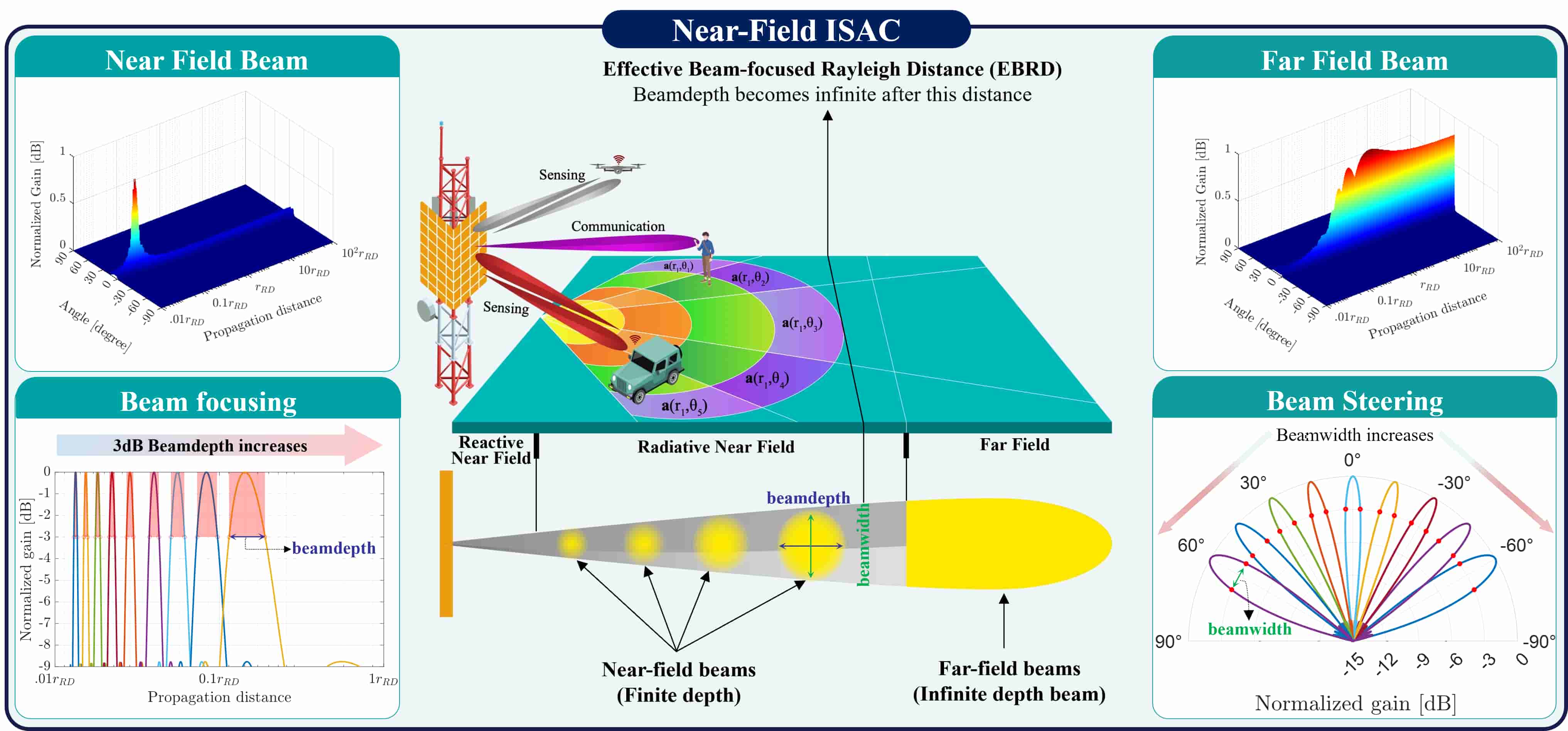
Near-field communication is deeply connected to integrated sensing and communication, or ISAC. In far-field systems, sensing often estimates angle, Doppler, and sometimes range. In near-field systems, the spherical wavefront naturally contains richer spatial information. This makes the same infrastructure potentially useful for both high-rate communication and precise sensing.
Our work on near-field hybrid beamforming for terahertz-band ISAC studied how to design hybrid analog/digital beamformers when near-field beam-squint degrades beamforming accuracy. Beam-squint is especially problematic in wideband terahertz systems because different subcarriers may effectively point in different directions. The proposed approach compensates near-field beam-squint using baseband beamformers, achieving satisfactory spectral-efficiency performance while supporting near-field ISAC operation without extra hardware [2].
A later near-field ISAC article developed a dual-purpose codebook and space-time adaptive processing framework. The idea is to use codebooks for both communication beam training and sensing-parameter estimation, then use those estimates to reduce the complexity of clutter mitigation and target detection. The proposed framework can reduce STAP complexity by three orders of magnitude, showing how near-field communication and sensing can reinforce each other rather than compete for resources [8].
In simple terms, near-field ISAC turns the wireless link into a perceptive instrument. The network does not only connect users; it understands where they are, how far they are, and how they move.
Seeing motion in the near-field
Near-field sensing also changes the motion-estimation problem. In conventional far-field models, parameters such as angle and Doppler are often easier to separate. In near-field systems, location and motion become coupled: angle, range, radial velocity, and transverse velocity interact through the spherical wavefront.
Our work on joint motion, angle, and range estimation addresses this challenge by projecting the received space-time signal into the angle-Doppler domain. The resulting angular and Doppler spreads carry information about the target’s range and transverse motion. By exploiting these structures, the proposed method estimates location and velocity efficiently and accurately, while greatly reducing computational complexity compared with maximum-likelihood estimation [9].
This is an important step toward near-field networks that can track not only devices, but also movement patterns in dynamic environments.
Near-field security: focusing energy, shrinking exposure
Near-field focusing also has implications for security. If wireless energy can be focused in a spatial region, then legitimate users can be served more precisely while unintended receivers outside the focal zone receive less useful signal. At the same time, the existence of a finite focal region creates new security questions: what happens if an eavesdropper enters the vulnerable zone?
Our recent work on RIS-assisted near-field physical-layer security studies this problem in millimeter-wave in-band full-duplex systems. The framework uses artificial noise and near-field beam focusing to support confidential bidirectional transmission while suppressing information leakage to unintended receivers. It jointly configures transmit powers and RIS phase shifts to improve secrecy while preserving quality-of-service requirements for legitimate users [10].
This direction shows that near-field communication is not only about speed. It may also reshape how we think about physical-layer privacy and secure zones.
Toward spatially intelligent 6G
Near-field communication is one of the clearest examples of how 6G will differ from previous generations. It is not just a higher-frequency version of 5G. It changes the geometry of wireless networking.
The far-field era treated users mostly as directions. The near-field era treats users as points, regions, and trajectories in three-dimensional space.
This opens the door to spatially intelligent networks: systems that know where energy should be focused, which array shape best serves the environment, how to train beams without excessive overhead, how to sense motion while communicating, and how to secure links by controlling the physical distribution of signal power.
My near-field research addresses this transition across multiple layers: polar-domain codebooks, beam prediction, array geometry, sparse arrays, terahertz ISAC beamforming, dual-purpose communication/sensing codebooks, motion estimation, and near-field physical-layer security [11].
The broader vision is a wireless network that does not simply broadcast information through space. It shapes space itself.