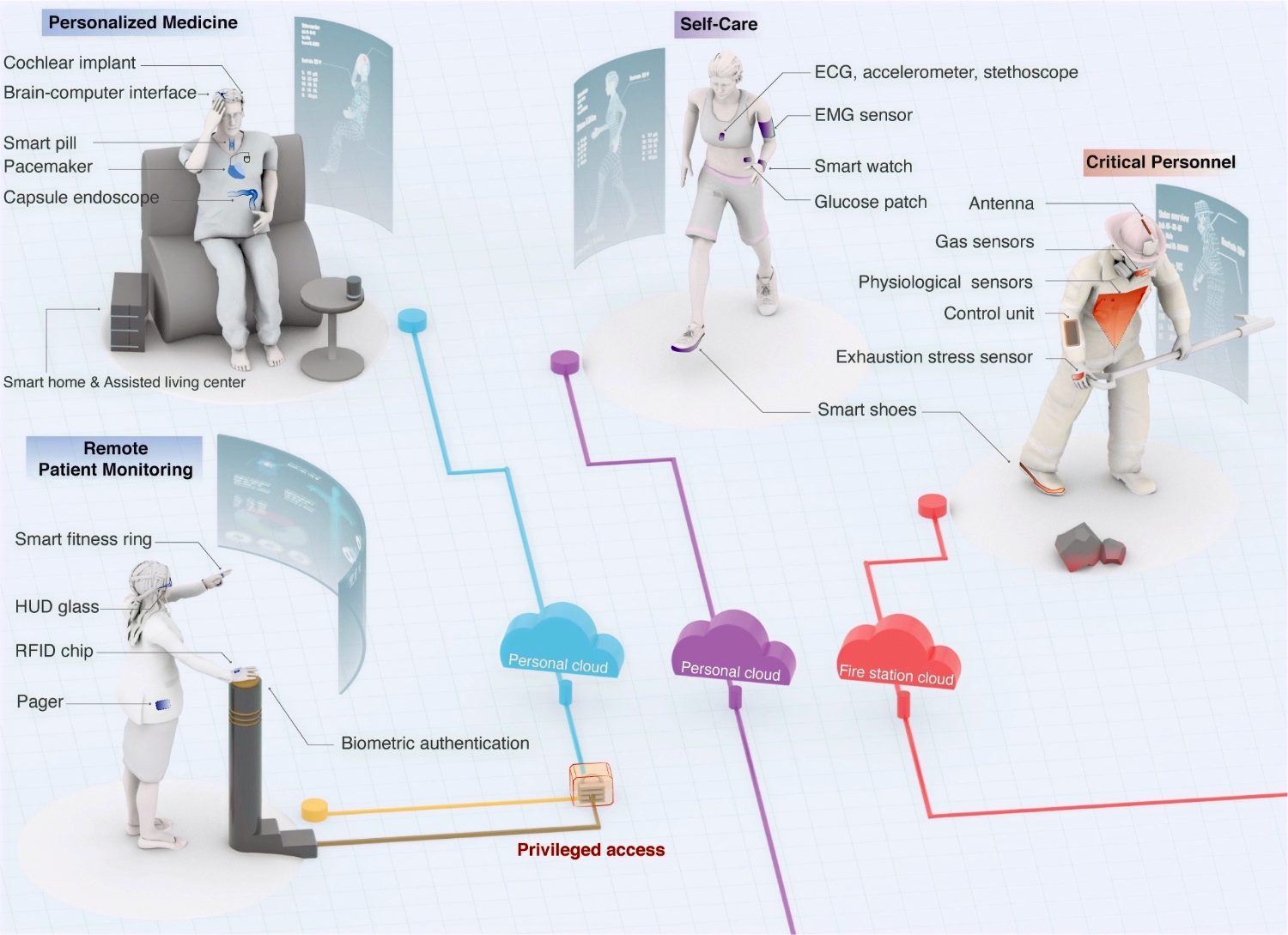
Most of today’s health data comes in fragments. A smartwatch measures heart rate. A patch records motion. A hospital device captures an electrocardiogram. A prosthetic arm may rely on muscle signals. Each device sees a small part of the person, but the future of digital health demands something more complete: continuous, secure, and context-rich information from in, on, and around the body.
This is the idea behind the Internet of Bodies, or IoB. It extends the Internet of Things from homes, factories, and cities to the human body itself. Its nodes may be wearable, implantable, ingestible, or even injectable. Together, they can support preventive medicine, remote monitoring, rehabilitation, wellness, personalized treatment, and eventually human digital twins: living digital models that help us understand health patterns before they become medical crises.
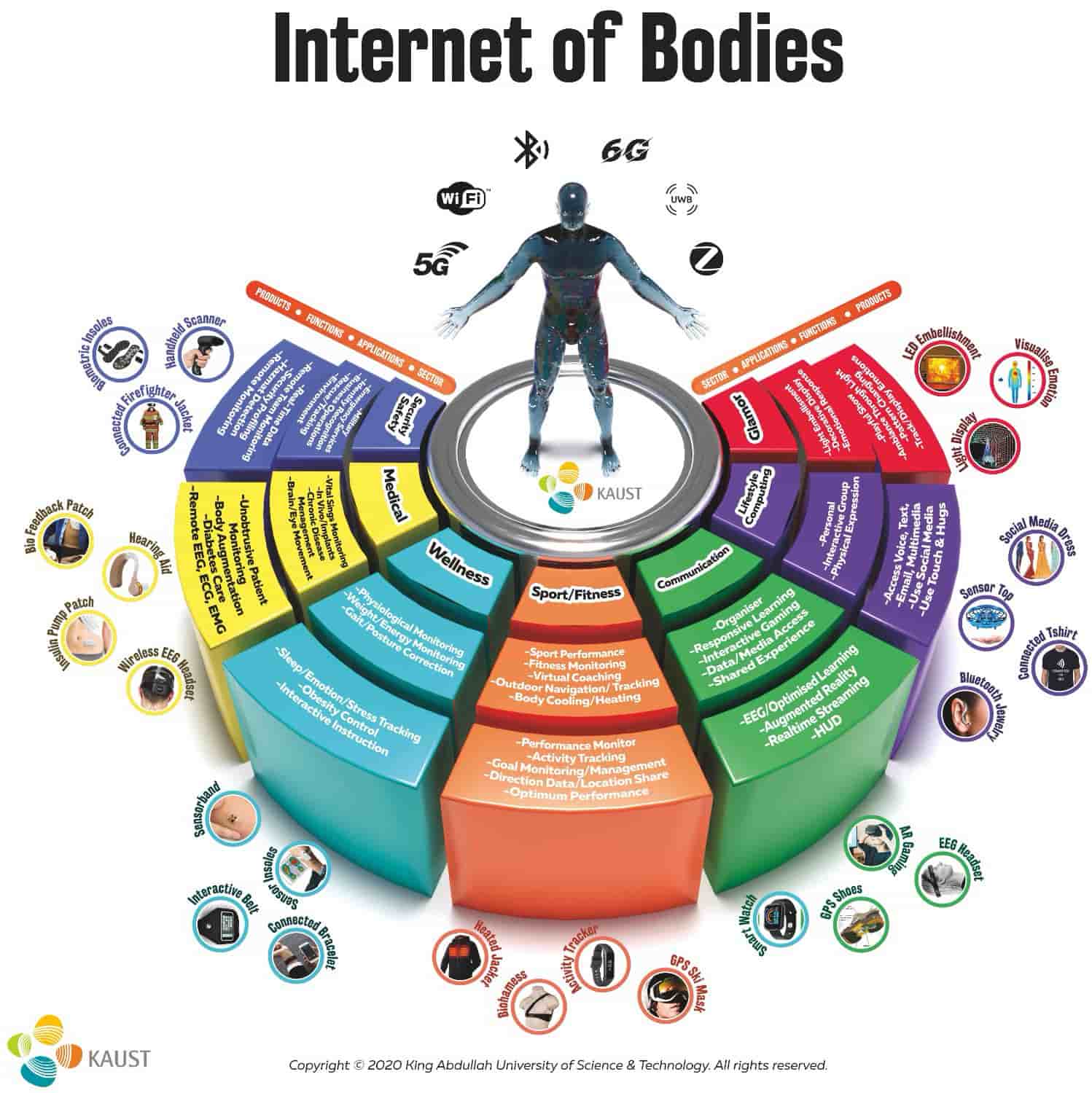
But IoB also raises a deceptively simple question: how should body devices talk to one another?
For many years, the default answer has been radio frequency communication — the same broad family of wireless technologies behind Bluetooth, Wi-Fi, and cellular systems. RF is mature and widely available. Yet for body-centric networks, it is not always the best fit. RF signals radiate outward, often far beyond the body. That can waste energy, create interference, and expose sensitive health data to unintended listeners.
My IoB research starts from a different premise: for many body-area applications, the best communication medium may be the body itself.
The body as a communication channel
Human body communication, or HBC, uses the body as part of the signal path. Instead of broadcasting strongly through the air, HBC couples very low-power electrical signals into the body and confines much of the communication near the person. In intuitive terms, it is less like shouting across a room and more like whispering through a private, body-centered channel.
This idea is attractive for three reasons. First, it can be far more energy-efficient than conventional RF links, which is crucial for small wearable or implantable devices. Second, because the signal is more localized, HBC can reduce interference with nearby devices. Third, reduced signal leakage can improve physical-layer privacy and security for sensitive physiological data.
My IoB vision paper made this case directly: the human body should not be treated only as a source of health data, but also as a communication medium that can connect smart body devices efficiently and securely [1].
Before networking comes understanding the channel
A communication system is only as good as its understanding of the channel. For IoB, that channel is unusually complex. Human tissue is lossy and heterogeneous. Body posture changes. Electrodes move. Clothing, environment, and device placement matter. A wrist-to-chest link is not the same as a chest-to-ankle link; an on-body link is not the same as an in-body or inter-body link.
That is why one of my first major contributions was a systematic survey of propagation characterization and channel modeling for the Internet of Bodies. The work mapped the landscape of body-centric channels: HBC below 100 MHz, narrowband RF links between 400 MHz and 2.5 GHz, and ultrawideband links from 3 to 10 GHz. It also examined capacitive, galvanic, and magnetic coupling, along with analytical, numerical, circuit-based, and empirical modeling approaches [2].
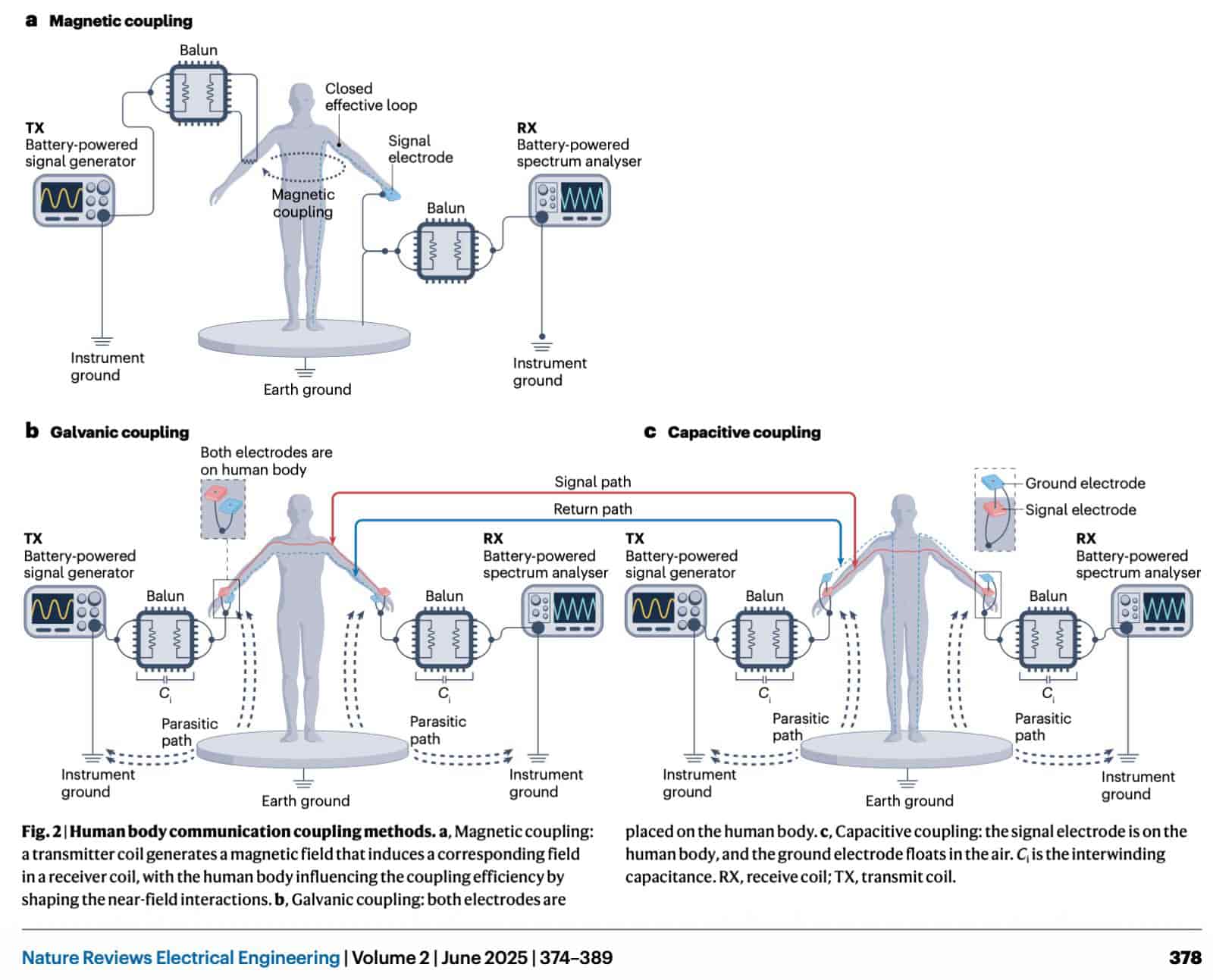
This survey helped frame a central research gap: IoB needs channel models that are not only accurate in ideal laboratory settings, but also useful under real human movement, posture variation, device placement, and hardware constraints.
A follow-up channel-characterization study focused on electro-quasistatic capacitive-coupling HBC. It proposed a battery-powered measurement setup, developed a lumped circuit model, and studied how distance, frequency, ground-plane size, receiver capacitance, and resistance affect path loss. In practical terms, this work moves HBC closer to design rules that engineers can use when building real devices [3].
Multiple body devices, one shared body channel
A single wearable is useful. A network of body devices is transformative.
Imagine an IoB system with ECG sensors, EMG sensors, motion sensors, glucose monitors, temperature sensors, and rehabilitation devices all sharing the same body-centered communication medium. The challenge is no longer just one link. It becomes a networking problem: who transmits, when, at what power, and with what level of fairness?
In my work on capacitive body-channel access, we studied how multiple IoB nodes can share the body channel using orthogonal, non-orthogonal, and cooperative access schemes. The goal was to understand the tradeoffs among throughput, fairness, quality of service, and energy efficiency. The results showed that body-channel access can support multi-megabit-per-second communication even at extremely low transmit powers, and that cooperative schemes can help when the network grows or when some links are weak [4].
A later energy-efficiency-focused study extended this direction by analyzing body-channel network topologies such as point-to-point, medium-access, and broadcast channels. It derived closed-form power and time allocations for uplink and downlink body-channel networks, which is important because tiny IoB devices cannot afford heavy computation. For a health sensor, saving energy in the communication protocol can directly mean longer battery life, smaller form factor, and less intrusive use [5].
From theory to prototypes
A research vision becomes much more persuasive when it leaves the page.
Our wearable vital-signal monitoring prototype demonstrated a capacitive body-channel communication system using commercially available components. Designed around an IEEE 802.15.6-compliant carrier frequency, the prototype measured path loss and characterized bit-error rate and power efficiency. It achieved an energy efficiency of 8.3 nJ/bit at a maximum data rate of 1.3 Mbps [6].
We also demonstrated a flexible, miniaturized, low-power HBC health-monitoring system. The system used a flexible substrate and point-to-point HBC communication to show how body-channel devices can move toward wearable, affordable, and less intrusive health-monitoring platforms [7].
This prototype direction matters because IoB is not just a networking problem. It is also a form-factor problem, a comfort problem, a manufacturability problem, and a trust problem. A body network must disappear into daily life while still providing reliable data.
Learning to communicate through the body
The body channel is variable and difficult to model perfectly. This makes it a natural place to use machine learning — not as a buzzword, but as a way to design communication systems that adapt to complex real-world channels.
In our robust autoencoder HBC transceiver work, we combined autoencoder-based signal processing with conditional generative adversarial network channel modeling. The CGAN learned from real HBC measurements and generated realistic synthetic channel responses, which were then used to train the transceiver. The resulting architecture supports both narrowband and broadband operation, reaching 349 pJ/bit at 262.5 kbps in narrowband mode and 16 pJ/bit at 5.25 Mbps in broadband mode [8].
We also developed autoencoder-based transceivers for multiple-access HBC networks. Instead of designing each body device link independently, the transceivers are jointly trained so that multiple wearable nodes can share a common body channel. The system supports data rates from 164 kbps to 5.25 Mbps and shows improved performance over traditional IEEE 802.15.6-based approaches for two-user sharing [9].
The takeaway is simple: future IoB systems may not rely only on hand-designed waveforms and static protocols. They may learn how to communicate through the body more efficiently.
Medical signals without the wireless burden
One of the most compelling IoB applications is wireless electrography: ECG for the heart, EMG for muscles, and EEG for the brain. These signals are fundamental in hospitals, rehabilitation, prosthetics, and long-term monitoring. Yet conventional systems can still be wired, bulky, or dependent on RF links that are not ideal for body-area security and energy efficiency.
Our work on secure and efficient sEMG signal transmission using HBC targets upper-limb prostheses. Surface EMG signals are valuable for assisting people with physical disabilities, but transmitting them through RF can be energy-intensive and less secure. The proposed HBC transceiver uses an end-to-end autoencoder design tailored for sEMG applications, achieving a peak data rate of 62.5 kbps and an energy efficiency of 4.5 nJ/bit [10].
We also studied HBC transmission policies for energy-harvesting ECG nodes. The goal is to make ECG monitoring more sustainable by combining HBC with harvested energy. The work uses ECG signal characteristics to identify sensing and transmission durations, then formulates lightweight policies that maximize node lifetime under dynamic energy arrivals [11].
This is the direction IoB must move toward: health sensors that are low-power, secure, adaptive, and capable of operating for long periods without becoming a burden to the user.
Adaptive HBC chips for medical and everyday applications
Different IoB applications need different communication modes. Some require robust low-rate transmission. Others need higher data rates over short distances. A rigid transceiver design may not serve both.
Our adaptive dual-mode HBC transceiver addresses this by supporting both carrier-based and carrierless HBC in a unified 65 nm silicon design. The transceiver can switch among carrier-based operation across multiple carrier frequencies and carrierless operation for higher data rates. Measurement results show energy efficiencies of 25 pJ/bit in carrier-based HBC and 8.4 pJ/bit in carrierless HBC, with data rates up to 2 Mbps and 5.25 Mbps, respectively [12].
This matters because IoB should not be a single-purpose technology. The same body-channel foundation may support medical monitoring, prosthetics, wellness devices, entertainment interfaces, and future human-machine interaction.
Beyond vital signs: understanding behavior
IoB is not only about transmitting signals. It is also about interpreting them.
Chronic disease risk is deeply connected to physical activity, diet, sleep, and sedentary behavior. Many wearables can track motion, but recognizing eating behavior remains difficult. In our work on unobtrusive intake-gesture detection, we developed a machine-learning framework using wearable inertial sensors to identify eating-related gestures. The method uses optimized support vector machines and was evaluated across multiple datasets, achieving strong F1 scores while remaining suitable for real-time inference [13].
This complements the HBC side of the IoB vision. Body networks can collect physiological data; wearable intelligence can interpret behavior; together they can support human digital twins that understand not only what the body is measuring, but what the person is doing.
Toward human digital twins
The long-term vision is a secure, energy-efficient, and intelligent IoB ecosystem that enables human digital twins. Such a system would continuously integrate physiological, behavioral, and contextual data: heart activity, muscle signals, motion, activity patterns, dietary behavior, sleep, stress, and more.
But for human digital twins to become practical, the data pipeline must be trustworthy. Devices must communicate without draining batteries. Sensitive signals must not leak unnecessarily into the environment. Models must account for body diversity and motion. Hardware must be flexible, small, and comfortable. And algorithms must convert raw signals into useful, explainable insights.
My IoB research addresses these layers together: channel modeling, body-channel access, energy-efficient networking, HBC prototypes, adaptive transceivers, machine-learning-based communication, energy-harvesting ECG nodes, sEMG transmission for prostheses, and wearable behavioral sensing.
The broader message is that the human body is not merely a source of data. It can be part of the network itself. By treating the body as both biological system and communication medium, the Internet of Bodies can move digital health from occasional measurement to continuous, secure, and personalized care.