Wireless networks were built to communicate. A base station sends data, a device receives it, and the system tries to make that exchange faster, more reliable, and more energy-efficient.
But the next generation of wireless networks will need to do more than move bits. They will need to understand their surroundings.
A 6G network may need to know whether a car is approaching an intersection, whether a pedestrian is blocking a millimeter-wave link, whether a drone is entering controlled airspace, whether a robot is moving through a factory, or whether an object is inside a secure communication zone. Traditionally, these tasks belong to radar, cameras, LiDAR, or dedicated sensors. Communication systems and sensing systems have usually been designed as separate infrastructures.
Integrated sensing and communication, or ISAC, changes that.
The idea is simple but transformative: the same wireless signals, spectrum, antennas, and hardware can be used both to communicate and to sense. A base station can send data to users while also extracting information about targets, positions, velocities, ranges, blockages, and the surrounding environment.
In other words, future networks will not only connect the world. They will perceive it.
From connected networks to perceptive networks
Communication and sensing have always been related. A wireless signal travels through space, reflects off objects, scatters from surfaces, and arrives at receivers carrying traces of the environment. Communication systems usually treat many of these reflections as interference or fading. Radar systems, by contrast, treat reflections as information.
ISAC brings these two views together. Instead of asking, “How do we remove the environment from the communication channel?” ISAC asks, “How can we use the environment to communicate and sense at the same time?”
This is especially important for 6G because future wireless systems will use high-frequency bands such as millimeter wave and terahertz. These bands provide wide bandwidth and high spatial resolution, making them attractive for both high-rate communication and accurate sensing. Large antenna arrays can form narrow beams, estimate angles, detect targets, and support high-capacity links.
The challenge is that communication and sensing do not always want the same thing. Communication wants strong links, high data rates, and low interference. Sensing wants accurate target detection, range estimation, velocity estimation, and clean radar echoes. ISAC research is about managing this tradeoff.
Cell-free ISAC: sensing from many viewpoints
One powerful way to improve sensing is to observe the world from multiple locations. A single base station sees the environment from one viewpoint. A distributed network of access points can see the same target from several angles.
This is the motivation behind cell-free ISAC. In a cell-free massive MIMO system, many distributed access points jointly serve users rather than relying on one central base station. For ISAC, this distributed architecture is especially attractive because multiple access points can improve target detection probability while still supporting communication users.
In our cell-free ISAC work, we designed hybrid beamformers that maximize sensing signal-to-noise ratio while maintaining communication quality-of-service constraints. The architecture combines the distributed benefits of cell-free MIMO with the dual function of ISAC: sensing and communicating over shared infrastructure [1].
The general-audience intuition is straightforward: if one pair of eyes is useful, many coordinated eyes are better. Cell-free ISAC gives the wireless network more viewpoints.
NOMA-aided ISAC: sharing spectrum among users and targets
ISAC becomes even more challenging when multiple communication users and radar targets share the same resources. This creates a new type of interference: not only user-to-user interference, but also interference between communication and sensing functions.
Our work on NOMA-aided ISAC addresses this problem by combining ISAC with non-orthogonal multiple access. NOMA allows multiple users to share the same time and frequency resources, while signal processing separates them. In an ISAC setting, this opens a new design space: communication users and radar targets can be paired, power can be allocated, and beams can be shaped to balance data throughput and sensing accuracy.
In the journal work, we developed multi-armed bandit approaches that jointly optimize user-target pairing, power allocation, and beamforming. The methods manage interference between the communication and radar tasks while learning efficient pairings with much lower complexity than exhaustive search. The proposed algorithms outperform conventional techniques by an average of 65%, while approaching exhaustive-search performance with around 95% less computational complexity [2].
A related PIMRC paper focused on the online-learning aspect of user-target pairing. It showed that multi-armed bandits can identify effective communication-user/radar-target pairings while dramatically reducing complexity [3].
The broader message is that ISAC is not just about adding radar to a base station. It requires intelligent resource sharing among data streams, beams, users, and sensed objects.
Index modulation: sending data through paths
One of the most distinctive threads in my ISAC research uses index modulation.
In conventional communication, information is usually carried by modulating signal amplitude, phase, or frequency. Index modulation adds another possibility: information can also be carried by the choice of an index. For example, a system may encode bits in which antenna, subcarrier, or spatial path is activated.
This idea becomes powerful for ISAC because radar and communication already rely on spatial structure. If a base station is forming beams toward both radar targets and communication users, why not use the spatial paths themselves to carry extra information?
In our spatial path index modulation ISAC work, we introduced SPIM-ISAC, where additional bits are transmitted by modulating the indices of spatial paths between the base station and users. This helps compensate for the reduced multiplexing gains of hybrid beamforming architectures, especially at millimeter-wave and terahertz bands [4].
The RadarConf version introduced the idea for millimeter-wave radar beamforming with SPIM communications, showing that spatial-path index modulation can improve spectral efficiency and sensing beampattern performance compared with conventional mmWave-ISAC designs [5].
The later IEEE Transactions on Wireless Communications paper extended this into mmWave/THz-band ISAC, where SPIM helps address the limitations of hybrid beamformers and wideband operation [4]. A related GLOBECOM work further developed joint antenna and spatial path index modulation, exploiting both antenna and path indices to improve spectral efficiency in THz-ISAC systems affected by beam squint [6].
In simple terms, index modulation lets the network communicate not only by what signal it sends, but also by which spatial route it chooses.
The curse of beam squint
High-frequency ISAC systems often rely on very wide bandwidths. Wide bandwidth is good for data rates and sensing resolution, but it introduces a major complication: beam squint.
Beam squint means that different frequency components of a wideband signal point in different directions when the same analog beamformer is used across subcarriers. For communication, this can reduce signal strength. For sensing, it can distort the beampattern and degrade target estimation. For ISAC, it affects both functions at once.
In terahertz near-field ISAC, we developed hybrid beamforming methods that compensate for near-field beam squint using baseband beamformers. This is important because THz systems use large arrays and wide bandwidths, making beam-squint effects particularly severe [7].
In sparse-array ISAC, we studied antenna selection and hybrid beamforming under beam squint. The goal is to reduce hardware cost and power consumption while maintaining acceptable communication and sensing performance. By using grouped subarrays, quantized performance metrics, sequential optimization, and learning-based antenna selection, the proposed approach reduces complexity by up to 95% for large antenna arrays with only a modest communication-rate loss [8].
The “curse of beam squint” article frames beam squint as both a challenge and a design consideration for future ISAC systems. It highlights why wideband ISAC must be designed with frequency-dependent beam behavior in mind, rather than treating it as a small hardware imperfection [9].
The lesson is clear: at THz and ultra-wideband frequencies, ISAC cannot simply scale old beamforming methods. It needs new signal processing designed for wideband physics.
ISAC with low-resolution hardware
Future ISAC systems may use very large antenna arrays. Fully digital beamforming with high-resolution data converters at every antenna can be costly and power-hungry. Practical systems will need lower-cost architectures.
Our work on ISAC hybrid beamforming with low-resolution digital-to-analog converters addresses this issue. It designs hybrid analog/digital beamformers while accounting for quantization distortion caused by low-resolution DACs. The base station generates multiple beams toward both radar targets and communication users, and the design balances spectral efficiency with sensing beampattern quality [10].
This is a practical step toward deployable ISAC. A future 6G base station cannot be only theoretically optimal; it must also be energy-efficient, affordable, and hardware-aware.
5G-NR as a sensing platform
ISAC is often discussed as a future 6G capability, but some sensing opportunities already exist in today’s cellular systems.
Our 5G-NR sensing work explores how the synchronization signal block, or SSB, can be used for network-side sensing. The SSB is already transmitted in 5G New Radio systems for synchronization and beam management. We studied how this existing signal can support multi-target detection and joint velocity, angle, and range estimation.
The proposed DBSCAN-based detection algorithm reaches an average detection accuracy of about 0.98 across different multi-target scenarios. The work also develops joint velocity-angle-range estimation methods that exploit the beam-sweeping nature of the SS burst [11].
This is important because it shows a migration path. ISAC does not have to wait for entirely new waveforms and infrastructure. Some sensing functions can be explored by reusing signals already present in 5G systems.
Near-field ISAC: sensing in angle and range
Near-field propagation changes the geometry of wireless sensing. In the far field, wavefronts are approximately planar, and beamforming mainly resolves angles. In the near field, large arrays and high frequencies create spherical wavefronts, enabling the network to focus energy and estimate parameters in both angle and range.
Our near-field ISAC work combines dual-purpose codebooks with space-time adaptive processing. DFT-based codebooks provide coarse sensing-parameter estimation, while polar-domain codebooks refine angle and range estimates. These estimates are then used to simplify clutter mitigation and target detection through a low-complexity STAP framework [12].
The key result is that the proposed framework can reduce STAP complexity by three orders of magnitude. The broader insight is that near-field ISAC can unify communication beam training and sensing-parameter estimation rather than treating them as separate tasks.
A related near-field motion-estimation work studies joint motion, angle, and range estimation under array calibration imperfections. It exploits angle-Doppler structures to estimate target location and velocity efficiently, greatly reducing computational complexity compared with maximum-likelihood estimation [13].
Near-field ISAC points toward wireless systems that do not merely detect a direction. They perceive spatial position, motion, and depth.
Full-duplex ISAC: sensing while transmitting and receiving
Full-duplex systems transmit and receive at the same time over the same frequency band. Combining full duplex with ISAC is attractive because it can improve spectrum efficiency and enable simultaneous sensing and communication. But it also creates a serious problem: self-interference.
In our MIMO in-band full-duplex ISAC work, we studied multi-target sensing in a system that transmits and receives simultaneously. The proposed framework uses independent component analysis to separate self-interference from desired radar echoes, along with a specialized multi-target detection method to recover reflected radar signals [14].
This line of work is important for vehicle-to-everything and 6G scenarios where systems may need to communicate, listen, and sense at the same time. Full-duplex ISAC is difficult, but it brings the network closer to real-time perception.
Sense and jam: ISAC for physical-layer security
ISAC can also improve wireless security. In conventional physical-layer security, the system may transmit artificial noise to confuse eavesdroppers. But a key question remains: where are the potential eavesdroppers? ISAC helps answer that by sensing the environment while communicating.
Our “Sense and Jam” work uses a full-duplex dual-functional access point to establish a secure communication zone. The access point senses targets, detects undesired users in the zone, and then beams artificial noise to obstruct eavesdropping while maintaining communication with the intended user. The same infrastructure supports target sensing, optimal beam selection, and secure transmission [15].
This is a powerful example of why sensing and communication belong together. A secure network should not only encrypt data; it should also perceive who is nearby.
Multi-modal ISAC: sensing beyond radio echoes
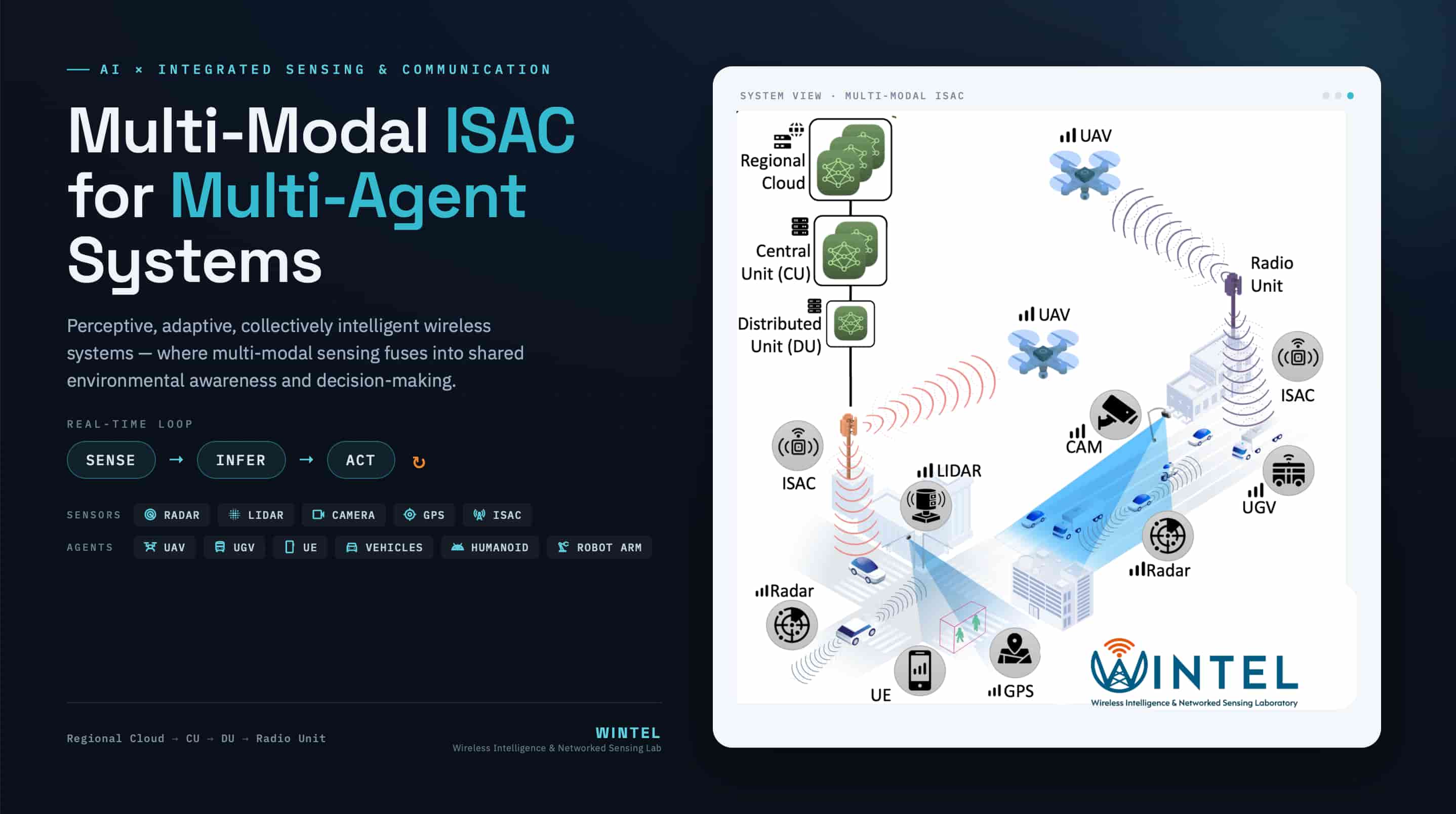
ISAC does not have to rely only on radio reflections. A future wireless network may also use cameras, LiDAR, radar, GPS, inertial sensors, and large language models to understand the environment before the radio link fails.
This is especially important for millimeter-wave and terahertz networks, where narrow beams can deliver high data rates but are highly vulnerable to blockage. A truck, pedestrian, or nearby vehicle can suddenly obstruct the line-of-sight path. A purely radio-based system may detect the problem only after the signal quality drops. A multi-modal ISAC system can see the problem coming.
Our work on multi-modal V2V beam tracking uses camera and GPS fusion to support proactive beam tracking in vehicle-to-vehicle networks. Instead of treating beam alignment as a blind radio search problem, the system exploits visual and positional information to infer how the wireless link is likely to evolve. This work connects ISAC with situational awareness: the network uses sensing information to maintain communication before disruption occurs [16].
A follow-up target-in-the-loop beam-tracking study further develops this idea by combining GPS and LSTM-based prediction for proactive millimeter-wave V2V networks. The key point is that the communication target is no longer just a receiver; it becomes part of a sensed and predicted mobility process. By learning how target motion evolves, the network can anticipate beam changes rather than reacting after misalignment [17].
A related blockage-prediction work combines camera, GPS, LiDAR, and radar inputs to predict blockage in millimeter-wave vehicular networks. The system can forecast blockage up to 1.5 seconds in advance, giving the network time to adapt before the communication link fails [18].
The ENWAR research line expands multi-modal ISAC into environment-aware reasoning. ENWAR 1.0 introduced a RAG-empowered multi-modal LLM framework that integrates GPS, LiDAR, and camera inputs to interpret wireless environments, identify positions, analyze obstacles, and assess line-of-sight conditions [19]. ENWAR 2.0 added agentic reasoning and beam-tracking capabilities, combining environment perception with specialized beam-prediction agents [20]. ENWAR 3.0 moves toward real-time orchestration: it detects sensor degradation, dynamically selects sensor-specific models, and coordinates specialized agents for beamforming, blockage prediction, and handover management [21].
Together, these works broaden ISAC from “using radio signals as radar” to “building situation-aware wireless intelligence.” The network does not merely estimate a target’s range or velocity. It fuses multiple views of the world, reasons about what is happening, predicts what may happen next, and adapts beams, handovers, and connectivity decisions accordingly.
This is where ISAC and AI-native wireless networks meet: sensing becomes the network’s perception layer, and communication becomes an adaptive action guided by that perception.
Sensing and communication in UAV cellular networks
ISAC also matters above the ground. UAVs and drones are increasingly expected to support emergency response, data collection, inspection, delivery, and future aerial mobility. But UAV cellular networks must solve a dual problem: they need to communicate reliably while also maintaining awareness of aerial nodes, ground users, and the surrounding environment.
In our UAV cellular network work, we studied the design and optimization of sensing and communication for aerial platforms. The goal is to jointly account for communication performance and sensing needs, rather than designing the UAV link as a conventional data pipe alone [22].
This connects ISAC with non-terrestrial networks. As drones and eVTOLs become part of the 6G ecosystem, wireless infrastructure may need to provide both connectivity and airspace awareness.
Toward perceptive 6G
ISAC represents a major change in wireless thinking. Earlier generations of wireless networks were designed to deliver information. Future networks will deliver information while also extracting information from the world around them. The same signals may carry data, detect targets, estimate motion, predict blockages, guide beams, improve security, and support autonomous systems.
My ISAC research follows this transition across multiple layers: cell-free ISAC, NOMA-aided ISAC, spatial path index modulation, beam-squint-aware THz ISAC, sparse arrays, low-resolution hardware, 5G-NR sensing, near-field ISAC, full-duplex multi-target detection, physical-layer security, multi-modal AI-native ISAC, V2V beam tracking, blockage prediction, handover management, environment-aware reasoning, and UAV sensing-communication design.
The long-term vision is a perceptive 6G network: one that does not only connect devices, but senses, understands, and adapts to the environment in real time.