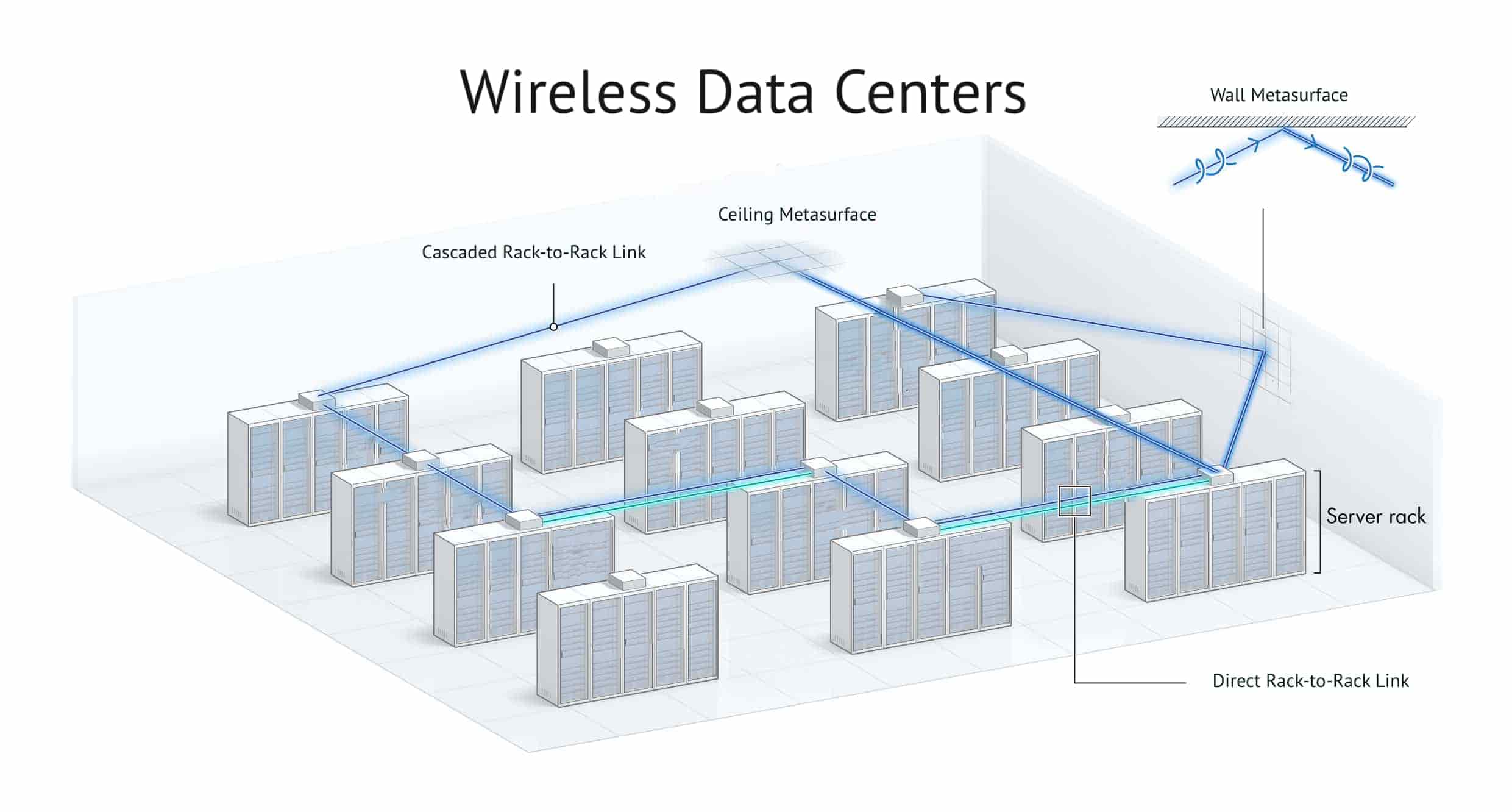
Every time we ask an AI model a question, stream a movie, back up a photo, or run a cloud application, data moves through vast warehouses of servers. These data centers are the hidden factories of the digital world. Inside them, thousands of racks exchange information at extraordinary speed. But there is a physical catch: most data center networks are still built around fixed wired connections.
Wires are reliable, but they are also rigid. They create static paths in a world where traffic is anything but static. At one moment, one group of racks may be exchanging massive files for distributed machine learning. A few milliseconds later, another set of servers may need rapid, delay-sensitive communication for an interactive service. This uneven and unpredictable traffic creates “hotspots,” where some network links become congested while others remain underused.
My work on optical wireless data center networks asked a simple question: what if the data center could create extra high-speed links on demand?
Lightpaths inside the data center
The idea is to augment the wired data center fabric with multi-gigabit optical wireless links, often called lightpaths. Instead of relying only on fixed cables and electronic switches, racks can communicate through free-space optical connections that are rapidly provisioned when and where traffic demand appears.
In our traffic-grooming framework, the data center does not treat all flows the same. It distinguishes among mission-critical flows, mice flows, and elephant flows. Mice flows are small but often delay-sensitive; elephant flows are large and bandwidth-hungry; mission-critical flows require special priority. Mixing all of them on the same congested path is like letting emergency vehicles, bicycles, and freight trucks fight for a single narrow lane.
The proposed solution groups compatible flows into rack-to-rack optical lightpaths. Mice and mission-critical flows can be groomed onto carefully provisioned rack-to-rack paths, while elephant flows can be sent over dedicated express lightpaths whose capacity and routes are chosen dynamically. To protect mission-critical traffic, the framework also models high- and low-priority queues and studies delay, waiting time, hop count, and blocking probability.
The result is a more flexible data center network: bandwidth is used more efficiently, flows complete faster, and congestion can be avoided by separating traffic classes rather than forcing every flow through the same infrastructure [1], [2].
The missing piece: knowing the flow before it is too late
The first step assumed that the network already knew whether a flow was a mouse or an elephant. In practice, that information is not always available early enough. A flow may begin looking harmless, then grow into a bandwidth-hungry elephant that congests shared resources.
That challenge led to LightFDG, an integrated flow detection and grooming framework for optical wireless data center networks. LightFDG combines two functions that are often treated separately: detecting the type of flow and grooming it onto the right optical path.
The detection part uses clues from TCP behavior to classify flows quickly and accurately. It can be implemented inside the network for modifiable hosts or centrally for unmodifiable hosts. Once the flow class is known, LightFDG grooms mice and elephant flows into separate rack-to-rack aggregates and forwards them over separate virtual optical topologies.
This matters because timing is everything. Detecting an elephant flow after it has already filled a queue is too late. LightFDG showed that fast flow detection can translate directly into better network performance, outperforming traditional load balancers by around 3× for elephant flows and 10× for mice flows. Its centralized version also reduced overhead by up to 62× while maintaining 100% accuracy and achieving much faster detection than existing centralized approaches [3], [4].
Soft reconfiguration: reacting without moving the hardware
Optical wireless data centers also raise an important operational question: should every traffic change require reconfiguring physical lightpaths? Not necessarily.
SoftFG explores a lighter approach: soft reconfiguration. Instead of changing the physical topology whenever congestion appears, SoftFG reacts using fine-grained network statistics and reroutes flows over underutilized wavelengths or links. It keeps visibility over network paths, detects congestion early, and responds quickly through software modules installed on virtual switches or hypervisors.
This makes the network agile without being disruptive. In emulations, SoftFG delivered much faster flow completion times than conventional load balancers such as LetFlow and CONGA [5].
Toward flexible, wireless, and intelligent data centers
The broader vision is not to replace wired data centers overnight. Rather, optical wireless links can act as a reconfigurable high-speed relief system: extra lanes that appear when traffic surges, vanish when no longer needed, and adapt to the changing geography of computation [6].
The next challenge is deployment. Optical wireless, millimeter-wave, and terahertz links are highly directional, so maintaining line-of-sight between racks is nontrivial in real data center layouts. Racks are arranged in rows, equipment blocks direct paths, and the very geometry that makes data centers compact also makes wireless connectivity difficult.
This is where our recent patent, “Apparatus, Systems, and Methods for Metasurface-Assisted Wireless Data Centers,” extends the vision. The invention proposes placing reconfigurable intelligent surfaces, or RIS modules, on walls, ceilings, racks, and other parts of the data-center environment. These metasurfaces act like programmable mirrors for electromagnetic waves: instead of forcing every wireless link to rely on a direct path, the data center can steer, reflect, and reshape signals to create single-hop or multi-hop line-of-sight wireless links among racks, servers, and switches.
In the patented architecture, a global controller monitors traffic demand and determines when a new wireless link is needed between data-center components, such as racks or core switches. It then calculates the direction of the desired link, selects suitable RIS modules distributed around the data center, and coordinates local controllers so that the received electromagnetic signal is re-emitted toward the intended destination while carrying the same information. In simple terms, the network does not merely route packets through switches; it can also program the physical environment to create new wireless paths when traffic demands them [7].
This turns the data center from a fixed communication layout into a software-defined wireless environment. Active, passive, or hybrid RIS blocks can support low-power and scalable wireless connectivity, while hybrid wired–wireless topologies can preserve the reliability of cables and add the agility of controllable beams. For future cloud, AI, and 6G workloads, this points toward a data center that is not only fast, but spatially intelligent: one that can reshape its own communication fabric in response to the workloads it serves.