Prof. Abdulkadir ÇelikResearchInteractive site →
← All posts
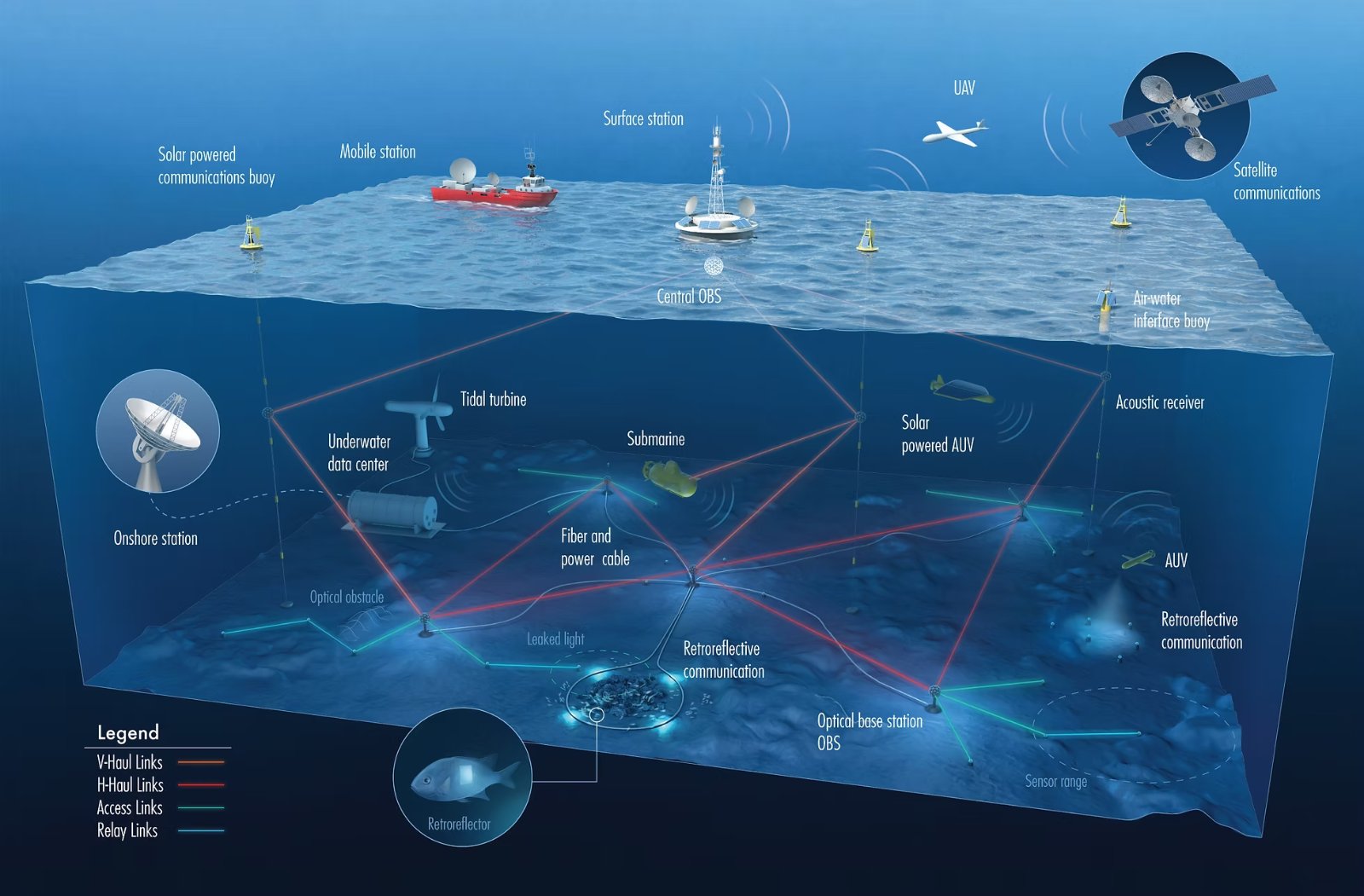
A software-defined opto-acoustic IoUT architecture: surface and onshore stations, optical base stations (OBS), AUVs, and sensor nodes linked by vertical-/horizontal-haul, access, and relay links over hybrid optical (red/green/cyan) and acoustic channels. Figure from our IEEE Communications Magazine article on SDN/NFV for IoUT.
OWC2024

Opto-Acoustic Internet of Underwater Things

Oceans cover roughly 71% of the Earth’s surface and underpin much of life on it, yet about 95% of them remain unexplored, largely because the underwater environment is so unforgiving to the tools we rely on above the surface. An Internet of Underwater Things (IoUT) could open a new era of ocean applications, but its communication, networking, and localization differ from terrestrial IoT in almost every respect. [1], [6]

The trade-off is fundamental. Underwater acoustic networks (UANs) reach long distances of 1 to 10 km but are throttled to tens of kbps and suffer highly variable delay, because acoustic signals have limited bandwidth and travel at only ~1500 m/s. Underwater optical wireless networks (UONs) flip those constraints: at the cost of short range (under ~200 m), light propagates at ~2.55×10⁸ m/s and delivers low-latency, gigabit links. My IoUT research hybridizes the two, optical and acoustic, so the network can complementarily reap the benefits of both. [4]

Network localization

Localization is paramount for optical underwater networks, for three reasons: the optical link budget depends heavily on pointing and alignment; multi-hop and geographical routing need node positions; and sensory data is only useful if it is tied to a location. On top of harsh channel impairments, limited battery is a second hard constraint, since recharging or replacing a submerged node is a formidable task.

We first studied how the duty cycle of energy-harvesting IoUT nodes affects localization. Rather than the usual shortest-path approach, our method reduces the estimation error of each block kernel matrix and yields a closed-form estimator for every optical node, reaching within a few centimeters of the Cramér–Rao lower bound depending on range and anchor count. [8], [10] A higher energy-arrival rate keeps more nodes active, producing more received-signal-strength (RSS) measurements and, in turn, sharper localization.

A follow-up fused noisy RSS from both optical and acoustic nodes under a weighted multiple-observations scheme that trusts accurate observations more. [10] Because anchor placement matters so much, we then analyzed how anchor-position uncertainty degrades 3D localization (exploiting time- and angle-of-arrival instead of RSS), and found a degradation that simply adding more anchors cannot fix. [3], [13]

Connectivity and routing

Connectivity and localization are interwoven: denser connectivity gives more RSS measurements and better localization, while better location knowledge enables the precise pointing that sustains reliable multi-hop links. Inspired by the conical shape of light beams, I modeled UONs as randomly scaled sector graphs and quantified the probability of connectivity as a function of node density, range, and the optical transmitters’ divergence angle. [11], [12] End-to-end performance of multi-hop decode- and amplify-and-forward links was analyzed under location uncertainty. [5], [7], [14]

To extend range, we proposed a distributed Light Path Routing protocol that leverages the range–beamwidth trade-off and works even without a pointing mechanism or a global view of the network. Building on the lessons of pointing errors, the broadcast nature of light beams motivated a Sector-based Opportunistic Routing (SectOR) protocol: instead of unicasting to one node, it targets a set of candidates to raise the packet-delivery ratio, selecting and prioritizing them by manipulating the rate–error and range–beamwidth trade-offs. SectOR also handles multimodal nodes that split control and data traffic across acoustic and optical channels, and in well-connected networks can outperform even optimal unicast routing. [2], [9]

A software-defined vision

These efforts grew out of a widely cited survey that laid out underwater optical wireless communication, networking, and localization layer by layer. [1], [6] My broader vision uses software-defined networking (SDN) and network function virtualization (NFV) to realize opto-acoustic IoUT: once the interwoven roles of the SDN layers are made explicit, NFV provides application-specific cross-layer protocol suites through a management-and-orchestration framework, turning a heterogeneous tangle of optical and acoustic links into a programmable whole. [4]
Top Collaborators

4
MAMohamed-Slim Alouini NSNasir Saeed TATareq Al-Naffouri BSBasem Shihada

References

14
  1. 1.

    A. Celik, I. Romdhane, G. Kaddoum, and A. M. Eltawil, “A Top-Down Survey on Optical Wireless Communications for the Internet of Things,” IEEE Commun. Surv. Tutorials, vol. 25, no. 1, pp. 1–45, 2023. DOI

  2. 2.

    A. Celik, N. Saeed, B. Shihada, T. Y. Al-Naffouri, and M.-S. Alouini, “Opportunistic Routing for Opto-Acoustic Internet of Underwater Things,” IEEE Internet Things J., vol. 9, no. 3, pp. 2165–2179, 2022. DOI

  3. 3.

    N. Saeed, A. Celik, M.-S. Alouini, and T. Y. Al-Naffouri, “Analysis of 3D localization in underwater optical wireless networks with uncertain anchor positions,” Sci. China Inf. Sci., vol. 63, no. 10, pp. 1–8, 2020. DOI

  4. 4.

    A. Celik, N. Saeed, B. Shihada, T. Y. Al-Naffouri, and M.-S. Alouini, “A Software-Defined Opto-Acoustic Network Architecture for Internet of Underwater Things,” IEEE Commun. Mag., vol. 58, no. 4, pp. 88–94, 2020. DOI

  5. 5.

    A. Celik, N. Saeed, B. Shihada, T. Y. Al-Naffouri, and M.-S. Alouini, “End-to-End Performance Analysis of Underwater Optical Wireless Relaying and Routing Techniques Under Location Uncertainty,” IEEE Trans. Wirel. Commun., vol. 19, no. 2, pp. 1167–1181, 2020. DOI

  6. 6.

    N. Saeed, A. Celik, T. Y. Al-Naffouri, and M.-S. Alouini, “Underwater optical wireless communications, networking, and localization: A survey,” Ad Hoc Networks, vol. 94, 2019. DOI

  7. 7.

    N. Saeed, A. Celik, M.-S. Alouini, and T. Y. Al-Naffouri, “Performance Analysis of Connectivity and Localization in Multi-Hop Underwater Optical Wireless Sensor Networks,” IEEE Trans. Mob. Comput., vol. 18, no. 11, pp. 2604–2615, 2019. DOI

  8. 8.

    N. Saeed, A. Celik, T. Y. Al-Naffouri, and M.-S. Alouini, “Localization of Energy Harvesting Empowered Underwater Optical Wireless Sensor Networks,” IEEE Trans. Wirel. Commun., vol. 18, no. 5, pp. 2652–2663, 2019. DOI

  9. 9.

    A. Celik, N. Saeed, B. Shihada, T. Y. Al-Naffouri, and M.-S. Alouini, “SectOR: Sector-Based Opportunistic Routing Protocol for Underwater Optical Wireless Networks,” Proc. IEEE Wireless Communications and Networking Conference (WCNC), pp. 1–6, 2019. DOI

  10. 10.

    N. Saeed, A. Celik, T. Y. Al-Naffouri, and M.-S. Alouini, “Energy Harvesting Hybrid Acoustic-Optical Underwater Wireless Sensor Networks Localization,” Sensors, vol. 18, no. 1, pp. 51, 2018. DOI

  11. 11.

    N. Saeed, A. Celik, T. Y. Al-Naffouri, and M.-S. Alouini, “Underwater Optical Sensor Networks Localization with Limited Connectivity,” Proc. IEEE International Conference on Acoustics, pp. 3804–3808, 2018. DOI

  12. 12.

    N. Saeed, A. Celik, T. Y. Al-Naffouri, and M.-S. Alouini, “Connectivity Analysis of Underwater Optical Wireless Sensor Networks: A Graph Theoretic Approach,” Proc. IEEE International Conference on Communications Workshops, pp. 1–6, 2018. DOI

  13. 13.

    N. Saeed, A. Celik, T. Y. Al-Naffouri, and M.-S. Alouini, “Robust 3D Localization of Underwater Optical Wireless Sensor Networks via Low Rank Matrix Completion,” Proc. 19th IEEE International Workshop on Signal Processing Advances in Wireless Communications (SPAWC), pp. 1–5, 2018. DOI

  14. 14.

    A. Celik, N. Saeed, T. Y. Al-Naffouri, and M.-S. Alouini, “Modeling and performance analysis of multihop underwater optical wireless sensor networks,” Proc. IEEE Wireless Communications and Networking Conference (WCNC), pp. 1–6, 2018. DOI

Explore this and other topics interactively — with live charts, the full publication list, and lab updates — on the main site: akadircelik.com.