For more than a century, wireless engineers have fought the environment. Buildings block signals. Walls reflect them. Moving people scatter them. At high frequencies such as millimeter wave and terahertz, even a small obstacle can turn a strong wireless link into a weak or broken one.
The traditional response has been to make transmitters smarter, receivers more sensitive, and antennas more directional. But reconfigurable intelligent surfaces, or RISs, ask a more radical question: what if the environment itself could become programmable?
An RIS is a surface made of many small controllable elements that can reflect, steer, or reshape electromagnetic waves. It is often described as a “smart mirror” for wireless signals. Unlike an ordinary wall, which reflects signals in a fixed and uncontrolled way, an RIS can be configured to redirect energy toward a user, reduce interference, improve security, or help several users share the same spectrum.
My RIS research has explored this idea from several angles: how to estimate RIS channels, how to train beams without excessive overhead, how to partition RISs among multiple users, how to combine RIS with NOMA and full-duplex systems, how to use RIS for physical-layer security, and how to move from theory toward experimental testbeds and digital twins.
From passive reflection to programmable propagation
RISs are exciting because they change the role of the wireless channel. In conventional wireless systems, the channel is something we measure and adapt to. With RISs, the channel becomes something we can partially design.
This is especially important for future 6G systems. Millimeter-wave and terahertz signals can provide enormous bandwidth, but they are also fragile: they suffer from high path loss, blockage, and directional alignment challenges. RISs can create additional propagation paths, improve signal strength, and make wireless links more resilient in environments where direct line-of-sight is not always available.
But there is a catch. To control an RIS, the network must know how signals travel through it. That is difficult because most RIS elements are passive: they reflect signals but do not actively receive, digitize, and process pilots like a conventional antenna array. This makes channel estimation one of the first major RIS bottlenecks.
Learning the hidden RIS channel
In our work on RIS-aided millimeter-wave MIMO channel estimation, we studied how to estimate the cascaded channel between the transmitter, the RIS, and the users with limited training overhead. The problem is challenging because large RISs create high-dimensional channels, and wideband millimeter-wave systems introduce frequency-selective behavior.
The proposed methods combine deep learning and compressive sensing. The key observation is that high-frequency channels are sparse in the angular domain, and different users and subcarriers often share structural similarities. By exploiting common sparsity and double-structured sparsity, the framework reduces training overhead and computational complexity while approaching the performance of idealized lower bounds [1].
This work addresses a foundational question: before an RIS can intelligently reshape the environment, the network must first understand the environment.
Codebooks that learn the room
Even with better channel estimation, controlling an RIS remains hard. A large RIS may have hundreds or thousands of controllable elements. Exhaustively searching all possible phase-shift configurations is not practical.
That led to our work on deep reinforcement learning for RIS beam codebook design. Instead of relying on generic predefined codebooks, the system learns site-specific beam patterns from interaction with the environment. It uses received signal strength feedback rather than full channel state information, which makes the approach more practical for passive RIS deployments.
In the first version, a multi-agent deep reinforcement learning framework jointly designed the active beamforming at the base station and the reflection beam codebook at the RIS. By partitioning the RIS and associating beam patterns with the surrounding environment, the method dramatically reduced beam-training overhead. In one result, only six learned beams outperformed a 256-beam DFT codebook, corresponding to a 97% reduction in beam-training overhead [2].
The journal extension generalized this idea further with hierarchical beam training and multi-agent learning, showing that RISs can move beyond static, one-size-fits-all beam codebooks toward adaptive, environment-aware beam control [3].
A related distributed RIS study asked whether one large RIS is always the best architecture. Instead, smaller RISs can be distributed throughout the environment to exploit spatial diversity and reduce complexity. A multi-agent DRL framework then learns the beamforming and reflection codebooks using only received power measurements, reducing beam-training overhead by 89% while using only four beams [4].
The broader lesson is that RISs should not merely be installed; they should be trained for the places where they operate.
RIS partitioning: one surface, many jobs
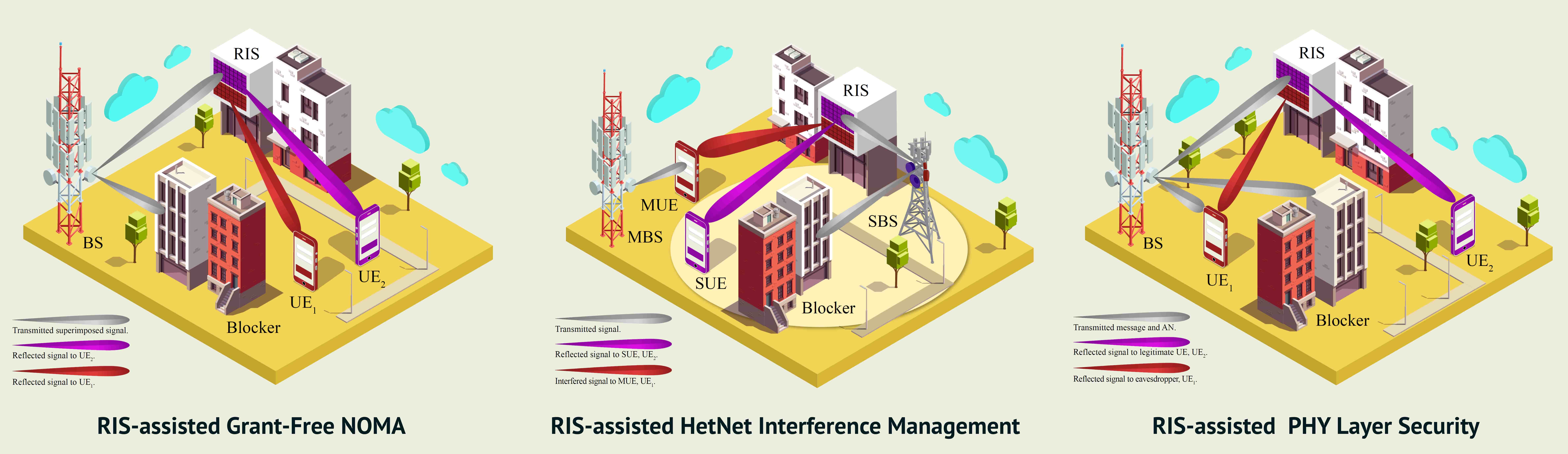
A single RIS does not have to act as one giant mirror. It can be virtually divided into several partitions, with each partition serving a different user or objective. This idea, RIS partitioning, became a recurring theme in my research because it makes RISs more flexible and practical.
Partitioning is particularly powerful when combined with non-orthogonal multiple access, or NOMA. NOMA allows multiple users to share the same time and frequency resources, but it needs sufficient power disparity among users to separate their signals. Traditionally, this requires power control at the user side. RIS partitioning offers another path: create power disparity over the air by assigning different RIS portions to different users.
In RIS-enabled over-the-air uplink NOMA, active and passive RIS partitions help users with identical transmit powers communicate in a NOMA fashion. The surface creates the needed received-power differences, reducing the need for complicated user-side power control [5]. This concept was extended to grant-free NOMA, where users can access resource blocks without waiting for scheduling grants. In RIS-assisted grant-free NOMA, the network jointly pairs users, assigns RISs, and aligns phase shifts so that users with different channel conditions can share resources efficiently, reducing signaling overhead and improving network sum rate over benchmark schemes [6].
We later studied optimal RIS partitioning and power control for bidirectional NOMA networks, deriving closed-form solutions under practical regimes such as quality-of-service feasibility, RIS efficiency, max-min fairness, and maximum throughput. The key insight is that uplink requirements can be handled through RIS partitioning, while downlink requirements can be met through base-station power control [7]. A PIMRC follow-up focused specifically on uplink grant-free NOMA and showed how optimal RIS partitioning can satisfy quality-of-service requirements while reducing signaling overhead and computational complexity [8].
In short, RIS partitioning turns one surface into a multi-purpose resource.
STAR-RIS: serving both sides of the surface
Conventional RISs reflect signals on one side. But future environments may require full-space coverage: users may appear on both sides of a surface. This motivates simultaneously transmitting and reflecting RIS, or STAR-RIS.
STAR-RIS can split incident signals into reflected and transmitted components, allowing the surface to serve users on both sides. In grant-free NOMA networks, STAR-RIS can support multi-level power disparity through clustering, assignment, and optimal partitioning. Our STAR-RIS-aided grant-free NOMA work showed that active and passive STAR-RIS realizations can provide significant throughput gains and fairness benefits [9].
We also studied STAR-RIS in bidirectional full-duplex communication. In this setting, the surface must support uplink and downlink users while respecting quality-of-service constraints. The proposed framework compared STAR-RIS operating protocols such as mode switching and energy splitting, showing how different modes affect bidirectional multiple-access performance [10].
The message is clear: as RIS hardware evolves, surfaces will not only reflect; they may transmit, split, switch, amplify, and coordinate.
Full duplex and self-interference
Full-duplex communication allows a node to transmit and receive at the same time over the same frequency band. In principle, it can double spectral efficiency. In practice, it creates a major problem: self-interference. A transmitter’s own signal can overwhelm its receiver.
RISs offer new ways to manage this problem. In our RIS-assisted full-duplex relay work, we analyzed a multihop full-duplex relaying system aided by RISs, deriving outage probability, spectral efficiency, and bit-error-rate expressions. RISs can improve performance, but the study also revealed an important limitation: simply increasing the number of RIS elements does not always translate into linear gains because of far-field path-loss effects [11].
A later study on RIS-assisted self-interference mitigation combined conventional RIS and STAR-RIS. The conventional RIS helped cancel self-interference at the full-duplex transceiver, while the STAR-RIS enhanced uplink and downlink connectivity. This illustrates a broader design principle: different RIS types can play different roles in the same wireless system [12].
RISs are not magic surfaces; they are engineering tools. Their value depends on where they are placed, how they are partitioned, and which physical-layer problem they are assigned to solve.
Physical-layer security: using the environment to protect information
Wireless security is usually discussed in terms of encryption. But security also has a physical dimension. If a signal leaks strongly toward an eavesdropper, the communication link becomes more vulnerable. RISs can help by shaping where useful signals and artificial noise go.
In our RIS-aided physical-layer security work, we studied virtual partitioning of RIS elements into two roles: one partition improves the intended signal at the legitimate user, while another enhances artificial noise toward the illegitimate user. This combination can improve secrecy capacity while satisfying quality-of-service constraints [13].
The aerial RIS version takes this idea into the sky. A UAV carrying an RIS can move to a favorable 3D location, strengthen the legitimate link, and help jam eavesdroppers. We derived closed-form secrecy-capacity expressions and optimized both the aerial RIS deployment and the RIS partitioning; the deployment approach converged in less than a second, making it suitable for dynamic scenarios [14].
An experimental study then brought learning into RIS-aided security. A reinforcement learning algorithm selected beams for RIS partitions without requiring channel state information and used a testbed to refine the approach. RIS partitioning enhanced secrecy capacity by an average of 55% over the full-RIS scenario while reducing computational complexity by about 80% compared with exhaustive search [15].
This is one of the most intuitive RIS applications: do not only transmit securely; shape the room so that the intended receiver hears clearly and the eavesdropper does not.
AI-native RIS: using sensors instead of channel estimates
One major barrier to RIS deployment is the cost of acquiring accurate channel state information. A different approach is to use situational awareness: cameras, inertial sensors, position estimates, and machine learning can help infer which beams are likely to work.
In our multimodal sensing and DRL-driven beam-selection work, a stereo camera mounted on the RIS detects users, while inertial measurement units provide 3D position information. A DRL framework then jointly optimizes RIS phase shifts and user beamformers through predefined codebooks, without requiring explicit channel estimation. The testbed results showed near-optimal sum rates while reducing computational complexity by 95% [16].
This is a glimpse of AI-native RIS operation. The surface does not blindly scan thousands of configurations. It sees, senses, learns, and adapts.
From lab measurements to digital twins
RIS deployment cannot rely only on idealized equations. Real rooms have cables, furniture, imperfect hardware, scattering objects, calibration errors, and unpredictable reflections. To bridge the gap between theory and practice, we explored RIS digital twins using ray tracing calibrated with experimental measurements.
In our lab-to-digital-twin work, we evaluated single-RIS, cascaded-RIS, and RIS-partitioning setups. The digital twin closely matched experimental received-signal-strength data, with an error below 1 dB for single and partitioned RIS setups and below 2 dB for cascaded RIS systems [17]. This matters because digital twins can reduce the need for expensive measurement campaigns, helping engineers test RIS placement, codebook design, and partitioning strategies before deploying hardware at scale.
Experimental proof: toward standardization
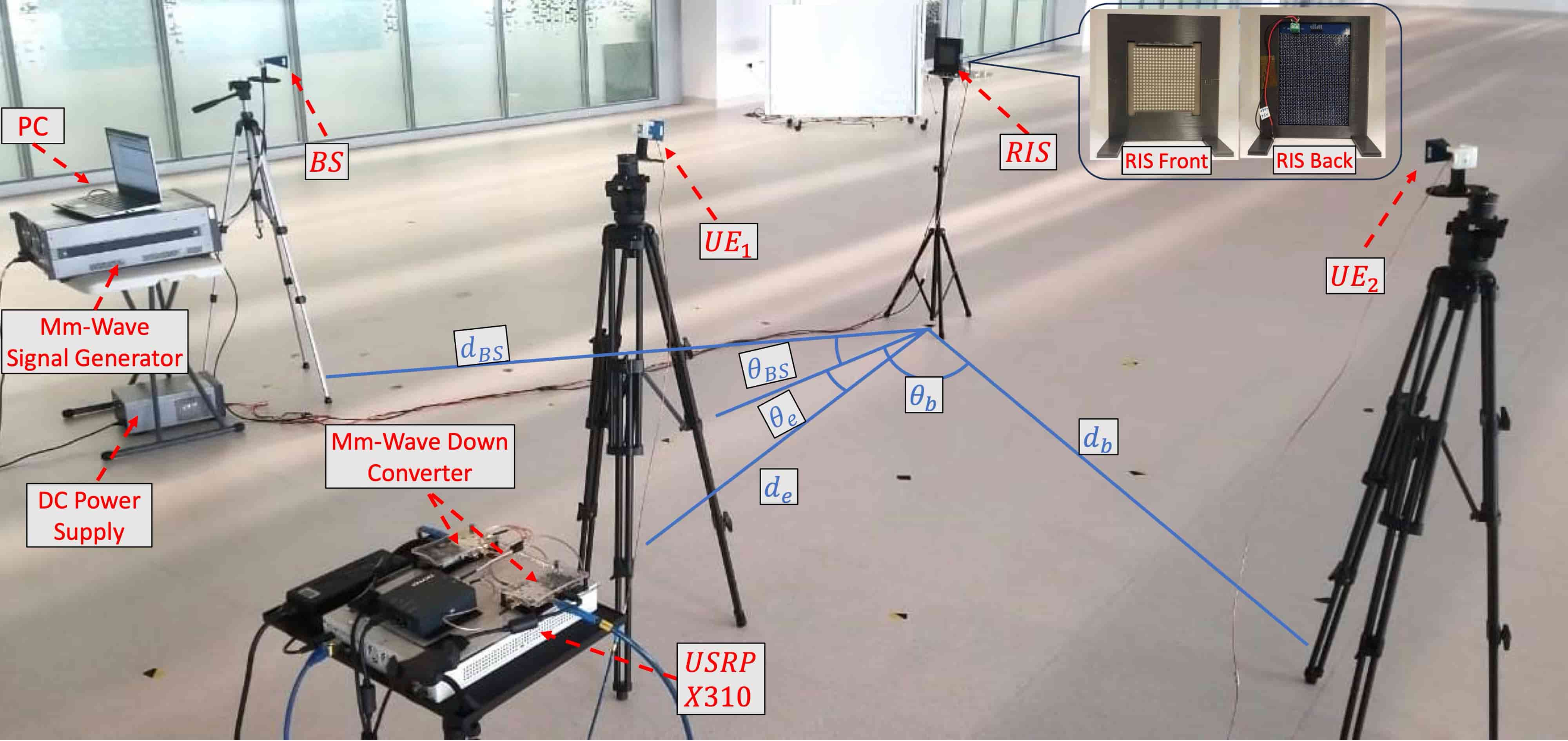
A major theme in my recent RIS work is moving from algorithms to proof-of-concept. The experimental RIS partitioning campaign studied millimeter-wave RIS partitioning across multiple scenarios: improving data rates in grant-free NOMA, managing interference in heterogeneous networks, and maximizing secrecy capacity in physical-layer security. By using the same partitioning idea across several applications, the work showed that RIS partitioning is not a niche trick but a versatile deployment principle [18].
This experimental direction is important for standardization. RISs will not become part of future wireless infrastructure simply because they are elegant in theory. They must be measurable, controllable, interoperable, and useful across realistic scenarios.
Toward programmable wireless environments
The long-term vision of RIS research is not just better coverage. It is a new philosophy of wireless design. In conventional networks, the environment is mostly passive and uncontrollable. In RIS-enabled networks, walls, panels, aerial platforms, and surfaces can become part of the infrastructure. They can help estimate channels, train beams, serve multiple users, enable grant-free access, secure links, support full-duplex operation, and adapt to sensed user locations.
My RIS research follows this path from fundamentals to deployment: channel estimation, learned beam codebooks, distributed RISs, RIS partitioning, STAR-RIS multiple access, full-duplex interference control, aerial RIS security, multimodal sensing, digital twins, and experimental validation.
The broader message is simple: future wireless networks will not only adapt to the environment. They will program it.