Wrap-up and Tutorial
Seven worked examples that revise the module. Each question comes with its learning outcome and context, the theory it draws on is recapped inside the solution, and the solution is built up step by step, with interactive figures wherever a parameter changes the answer.
- Recognise which result from Lectures 1–6 each question is testing
- Write complete, step-by-step solutions to source-coding, mutual-information and capacity questions
- Relate source information rates to the capacity and bandwidth a channel needs
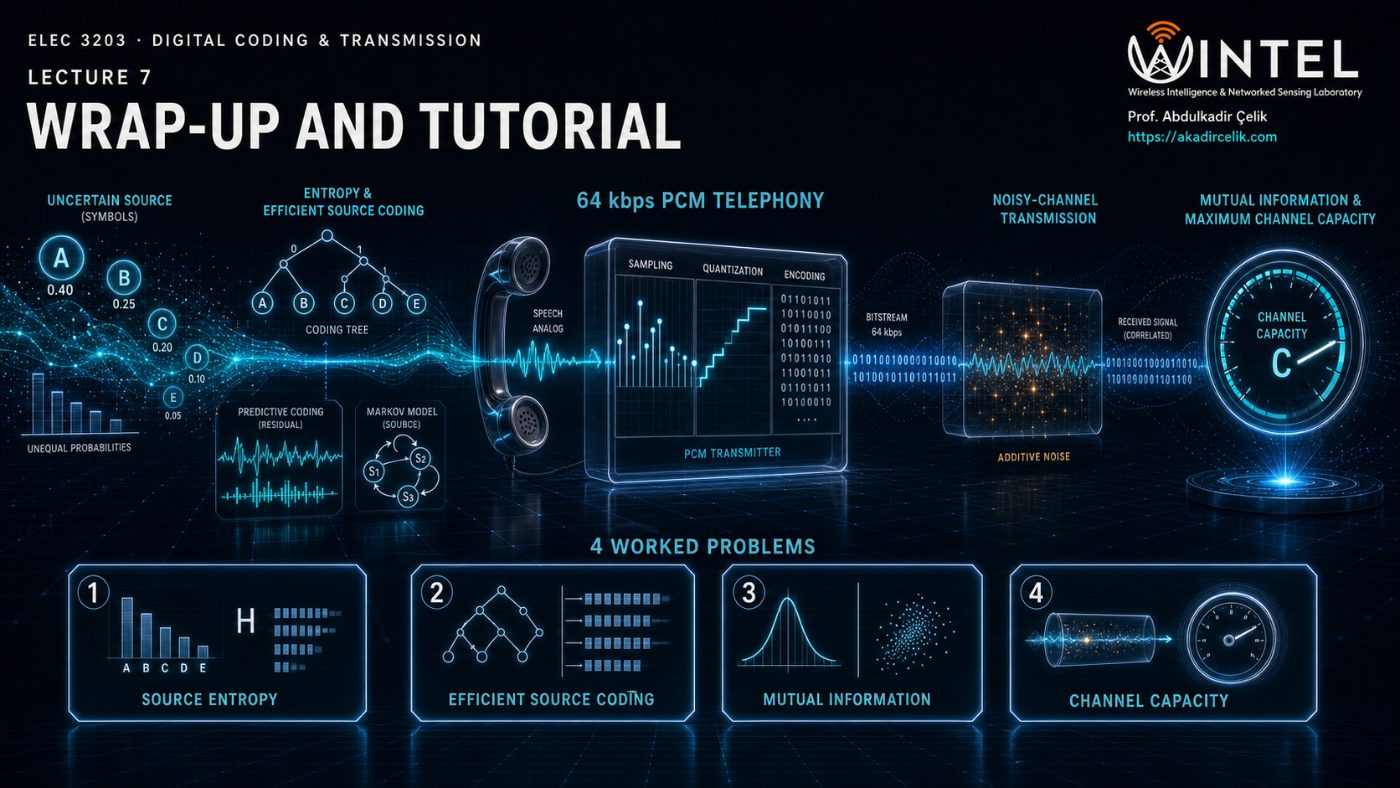
Contents
Seven worked examples: source coding first, then channels and capacity.
This lecture revises the module through seven worked examples, ordered from source coding to channels and capacity. Each example opens with its learning outcome and why it matters, then states the question with a diagram of its set-up. The solution gives the background for each part before working through it. Try each one before opening its solution.
7.1 Memoryless sources and sources with memory
Same symbols, different information
Compare the entropy and information rate of memoryless sources and sources with memory, and choose the right coding strategy for each.
This example states the general rule behind every practical source coder in this lecture, including the speech and video coders of Examples 7.2 and 7.4. Two sources that look identical symbol by symbol can carry different amounts of information, and the difference decides which coder should be used.
- The same source alphabet or symbol set of \(S=\{m_i,\ 1\le i\le q\}\);
- The same symbol probabilities of occurrence \(P=\{p_i,\ 1\le i\le q\}\), with \(p_i\) being the probability of \(m_i\) occurring;
- The same symbol rate of \(R_s\) [symbols/s]; and
- One digital source is memoryless, and the other has memory.
A memoryless source emits each symbol independently of the past, and its entropy depends only on the symbol probabilities (Lecture 1). A source with memory, such as a first-order Markov source (Lecture 3), chooses each symbol with probabilities that depend on the previous one, \(p_{ij}=P(m_j\mid m_i)\). Two entropies are therefore needed:
- \(H\), the memoryless entropy: computed from the symbol probabilities \(p_i\) alone. It is the entropy of the memoryless source, and also what any coder that looks at one symbol at a time sees, whichever source it is coding.
- \(H_M\), the entropy of the source with memory: the average uncertainty of the next symbol given the previous one. If the previous symbol is \(m_i\), the source is in state \(i\) and the next symbol has entropy \(H_i\) over row \(i\) of the transition matrix; \(H_M\) averages \(H_i\) over the states.
Figure 7.1.2 draws both cases with their transition matrices and entropies.
Knowing the previous symbol can only reduce the uncertainty about the next one, so for the same probabilities \(p_i\)
with \(H_M=H\) only when every row of the transition matrix equals the symbol probabilities, i.e. when the "memory" has no effect.
The memoryless source. Both sources have the same \(p_i\), so the memoryless entropy \(H\) of Eq. (7.1.1) is the same number for both; the source with memory has entropy \(H_M\le H\), Eq. (7.1.3). Part of each of its symbols is predictable from the previous one and carries no new information.
Also the memoryless source. Both emit \(R_s\) symbols/s, so \(R=H R_s\ge H_M R_s\). The two are equal only if the memory is trivial.
Entropy coders (Shannon-Fano, Huffman) assign codeword lengths close to \(-\log_2 p_i\), so their average length approaches \(H\) of Eq. (7.1.1) to within one bit per symbol (Lecture 2). Run-length coding suits a binary source in which one bit is far more likely than the other (Lecture 4).
Apply entropy coding directly to the symbols: Shannon-Fano or Huffman coding, or run-length coding if the source is binary with one bit far more likely than the other.
The symbols are independent, so there is no redundancy between them to remove; the only redundancy is unequal probabilities, \(\log_2 q-H\). Entropy coding removes exactly that, giving an average codeword length close to \(H\) and a bit rate close to the information rate \(R\).
An entropy coder applied directly to a source with memory still sees only the probabilities \(p_i\), so its average length cannot fall below \(H\), not \(H_M\). The gap \(H-H_M\) bits/symbol is redundancy carried by the dependence between successive symbols. Predictive coding (Lecture 4) removes it: the predicted part is not sent, and only the near-uncorrelated prediction error is coded.
First remove the redundancy caused by the memory, for example with a predictor that codes only the prediction error, then apply entropy coding to the resulting near-uncorrelated residual.
Entropy coding the raw symbols would give a rate close to \(H R_s\), wasting \((H-H_M)R_s\) bits/s, because the coder ignores the dependence between symbols. After decorrelation the residual is close to memoryless, so entropy coding it brings the rate close to the true information rate \(H_M R_s\). This is the two-step principle that Examples 7.2 and 7.4 apply to speech and video.
Same alphabet, same probabilities, same symbol rate: memory alone lowers the information rate, and only a coder that models the memory can benefit from it.
7.2 Remove redundancy, then entropy-code
Judging a speech coder by its information rate
Explain why a source with memory must be decorrelated before it is entropy coded.
Every practical compression standard, from the speech codec in a phone call to video streaming, is built on this idea. This example takes a real 1970s telephone speech coder and asks whether it suits a mobile handset, where bandwidth is scarce. Answering it connects three ideas from Lectures 1–4: entropy coding, companding and source memory.
An entropy coder (Shannon-Fano, Huffman or arithmetic coding) chooses codeword lengths from the symbol probabilities alone, and it approaches the entropy \(H\) only when successive symbols are independent. A source with memory carries less information per symbol than its symbol probabilities suggest (Lecture 3): part of every symbol can be predicted from the past, and coding that predictable part wastes bits. For a \(q\)-symbol source the entropies are ordered \(\sum_i P(X_i)H_i\le-\sum_i P(X_i)\log_2P(X_i)\le\log_2 q\): the first inequality is the saving from memory (conditioning on the previous symbol cannot increase uncertainty), and the second is the saving from unequal probabilities, with equality only for equiprobable symbols.
Speech amplitudes crowd around zero: small values are far more likely than large ones. A uniform quantiser with equal steps therefore uses its few central levels most of the time and its outer levels rarely. The A-law compressor, \(C(x)=\dfrac{A|x|}{1+\ln A}\) for \(|x|<1/A\) and \(C(x)=\dfrac{1+\ln(A|x|)}{1+\ln A}\) above it (with the sign of \(x\), and \(A=87.6\)), stretches small amplitudes and squeezes large ones before the uniform quantiser. Seen from the input, the steps become narrow near zero and wide at large amplitudes, so each step catches a similar share of the probability and the levels are used roughly equally often (Figure 7.2.2).
This makes a fixed 8-bit word per level close to an entropy code for the samples, treated one at a time.
The coder produces \(8\ \text{bits}\times 8000\ \text{samples/s}=64\) kbps. The A-law compressor makes the 256 quantiser levels roughly equiprobable, so coding each level with \(\log_2 256=8\) bits is an approximate entropy coding of the samples.
No. If the speech signal were memoryless, this design would be fine: it implements an approximate entropy coding whose rate is close to the source's information rate. But speech is highly correlated, so 64 kbps far exceeds the information rate of the speech source. A handset using it would need excess bandwidth for transmission.
Practical source coders work in two steps:
For a first-order model \(x(n)=\rho\,x(n-1)+\sqrt{1-\rho^2}\,w(n)\) with white \(w(n)\), the one-tap predictor \(\hat x(n)=\rho\,x(n-1)\) leaves the residual \(e(n)=x(n)-\hat x(n)\), whose power is
Only the prediction error \(e(n)\), the innovation, is quantised, entropy coded and sent; the predicted value \(\hat x(n)\) is never transmitted. The decoder runs the same predictor on the samples it has already reconstructed, forms the same \(\hat x(n)\), and adds the received \(e(n)\) to recover \(x(n)=\hat x(n)+e(n)\). The bits are spent only on what the past could not predict.
First remove the redundancy of the speech signal, then apply entropy coding to the resulting near-uncorrelated residual sequence.
In practice the redundancy is removed by prediction, and only the innovation \(e(n)=x(n)-\hat x(n)\) is coded. Today’s low-rate speech coders use much stronger predictors than the one-tap model of Figure 7.2.3, combining many past samples and the pitch period of voiced speech. A better prediction leaves a smaller prediction-error power \(\sigma_e^2\), Eq. (7.2.1); the innovation then carries less information, so fewer bits per sample are needed for the same quality. This is how mobile speech coders use bandwidth efficiently, reaching rates of a few kbps instead of 64 kbps.
The 1970s coder performs step 2 only. Figure 7.2.3 shows the saving step 1 makes possible, and real speech coders use far stronger predictors than one tap.
7.3 Entropy, efficiency and Huffman coding
Building and using a variable-length code
Construct a Huffman code and measure its gain over fixed-length coding using entropy and coding efficiency.
Fixed-length words such as BCD spend the same number of bits on every symbol, however likely it is. Huffman coding is the optimal symbol-by-symbol prefix code and appears inside JPEG, MP3 and ZIP. This example covers the complete workflow: find the information rate, build the code, compare efficiencies and decode.
| \(X_i\) | \(P(X_i)\) | BCD word |
|---|---|---|
| A | 0.27 | 000 |
| B | 0.20 | 001 |
| C | 0.17 | 010 |
| D | 0.15 | 011 |
| E | 0.07 | 100 |
| F | 0.06 | 101 |
| G | 0.05 | 110 |
| H | 0.03 | 111 |
For a memoryless source with symbols \(X_i\) emitted at \(R_s\) symbols/s (Lectures 1–2), the entropy and information rate are
Each BCD word has \(d=3\) bits: \(R_{\text{BCD}}=d\,R_s=3\times10^8=300{,}000{,}000\) bits/s.
Eq. (7.3.1), term by term:
so \(R=H\,R_s=2.6994905\times10^8=269{,}949{,}050\) bits/s.
Huffman coding builds the code from the bottom up:
- List the symbols in decreasing order of probability.
- Merge the two least probable entries into one entry with their summed probability; give the upper one bit 0 and the lower one bit 1.
- Re-sort and repeat until a single entry of probability 1 remains.
- Read each codeword from the last merge back down to the symbol.
| Step | Merge (bit 0 + bit 1) | New entry |
|---|---|---|
| 1 | G 0.05 + H 0.03 | GH 0.08 |
| 2 | E 0.07 + F 0.06 | EF 0.13 |
| 3 | EF 0.13 + GH 0.08 | EFGH 0.21 |
| 4 | C 0.17 + D 0.15 | CD 0.32 |
| 5 | EFGH 0.21 + B 0.20 | BEFGH 0.41 |
| 6 | CD 0.32 + A 0.27 | ACD 0.59 |
| 7 | ACD 0.59 + BEFGH 0.41 | 1.00 |
From step 7 back down to each symbol:
| Symbol | A | B | C | D | E | F | G | H |
|---|---|---|---|---|---|---|---|---|
| \(P(X_i)\) | 0.27 | 0.20 | 0.17 | 0.15 | 0.07 | 0.06 | 0.05 | 0.03 |
| Huffman | 01 | 11 | 000 | 001 | 1000 | 1001 | 1010 | 1011 |
With \(l_i\) the length of the codeword for \(X_i\), the average codeword length and the coding efficiency are
\(\bar L=3\) bits/symbol, so \(\eta_{\text{BCD}}=2.6994905/3=0.90=90\%\).
A, B have length 2, C, D length 3 and E–H length 4. Eq. (7.3.3):
A Huffman code is prefix-free: no codeword is the beginning of another. The decoder reads bits until they match a codeword, outputs that symbol and starts again, without separators or look-ahead. Continue Figure 7.3.2 past step 7 to watch each path.
01 | 11 | 000 | 1011 | 1010 | 1001 \(\to\) A B C H G F.
The Huffman code removes almost all of the 0.30 bits/symbol of redundancy in the BCD words.
7.4 Run-length coding
From video redundancy to a compressed bit stream
Apply the run-length coding equations to find a compression ratio, and decode a run-length coded stream by hand.
Once a video coder has removed spatial and temporal redundancy, its output is a long binary sequence dominated by zeros, and run-length coding is the standard way to compress it. This example links the principle of Example 7.2 to a calculation, then checks that you can run the decoder yourself, including the special all-ones codeword.
Video is a sequence of frames, each an array of pixels. Neighbouring pixels within a frame are similar (spatial, intra-frame correlation), and successive frames are similar (temporal, inter-frame correlation). The principle of Example 7.2 applies to both.
A fax page is the simplest image case (Lecture 4, Figure 4.3). Most pixels are white, and a pixel is very likely to have the same colour as its neighbour, so each scan line is a few long runs of white broken by short runs of black. Coding the run lengths instead of the individual pixels removes this spatial redundancy. Video coders apply the same idea to the residual left after removing the temporal redundancy between frames.
To encode a signal at a rate near its true information rate, its correlation or redundancy must be removed first.
Practical video source coders all remove the spatial and temporal redundancies first, then apply entropy coding to the resulting uncorrelated residual sequence. That residual is mostly zeros, which is the case run-length coding suits.
When a binary sequence has \(P(0)=p\) close to 1, coding it bit by bit is wasteful: its entropy \(H_b(p)\) is far below 1 bit. A run-length coder (Lecture 4) codes the lengths of the runs of zeros instead. With codeword length \(n\) bits and \(N=2^n-1\):
- a codeword of value \(l
- the codeword of value \(N\) (all ones) stands for \(N\) zeros with no closing 1 (\(N\) input bits).
The scheme counts runs of whichever bit is more likely. If instead \(P(1)=0.999\) and \(P(0)=0.001\), the coder counts runs of ones closed by a 0 (equivalently, invert the bits first); Eqs. (7.4.1)–(7.4.2) are unchanged with \(p=P(1)\).
A run of exactly \(l\) zeros then a 1 has probability \(p^l(1-p)\), and a full run of \(N\) zeros has probability \(p^N\). The average number of input bits per codeword is therefore
and since every codeword has \(n\) bits, the compression ratio is
\(n=10\), so \(N=2^{10}-1=1023\), and \(p=0.999\).
From Eqs. (7.4.1) and (7.4.2):
On average each 10-bit codeword replaces \(d=640.67\) input bits.
The RLC decoder reads the stream \(n\) bits at a time and inverts the mapping above: a value \(l
1111111101 \(=1021\): 1021 zeros then a 1. 0000000000 \(=0\): a single 1. 1111111111 \(=1023=N\): 1023 zeros with no closing 1, so this run continues. 1111111110 \(=1022\): 1022 more zeros then a 1, closing a run of \(1023+1022=2045\) zeros. 1111111101 \(=1021\): 1021 zeros then a 1.
Figure 7.4.2 also shows that \(n=10\) is not the best codeword length for \(p=0.999\).
7.5 The binary symmetric channel and mutual information
How much information survives a noisy binary link
Compute the joint and conditional probabilities and the mutual information of a binary symmetric channel, and turn the result into an error-free rate.
The binary symmetric channel is the simplest model of a noisy digital link: the demodulator of Lecture 6 turns an AWGN channel into one. Mutual information measures how much of the source’s information survives the channel, and its maximum is the channel capacity. The example asks first for intuition about the entropies, then for the full calculation.
A binary symmetric channel (BSC) flips each input bit with probability \(\varepsilon\). With \(P(X_0)=p\), total probability gives the destination probabilities
The binary entropy \(H_b(q)=-q\log_2q-(1-q)\log_2(1-q)\) is symmetric about \(q=\tfrac12\), where it peaks at 1 bit, and falls as \(q\) moves towards 0 or 1.
If \(p=0.5\), \(X_0\) and \(X_1\) are equiprobable, so \(Y_0\) and \(Y_1\) are also equiprobable and \(H(X)=H(Y)\). If \(\varepsilon=0\), \(P(Y_0)=P(X_0)\) and \(P(Y_1)=P(X_1)\), so again \(H(X)=H(Y)\).
\(H(Y)\ge H(X)\). By Eq. (7.5.1), \(P(Y_0)\) is a weighted average of \(p\) and \(1-p\), so it lies between them: the destination symbols are more balanced than the source symbols, and a more balanced binary distribution has higher entropy. Move the sliders in Figure 7.5.2 to see this.
The joint and conditional probabilities follow from the product and Bayes rules (Lecture 5):
The average mutual information is the information conveyed per symbol, and splits two ways:
Destination totals: \(P(Y_0)=\tfrac{15}{32}+\tfrac1{32}=\tfrac12\) and \(P(Y_1)=\tfrac1{32}+\tfrac{15}{32}=\tfrac12\).
Substitute into Eq. (7.5.3); the four terms pair up by symmetry:
For a BSC, \(H(Y\mid X)=H_b(\varepsilon)\) whatever \(p\) is, so \(I(X,Y)=H(Y)-H_b(\varepsilon)\) is largest when \(H(Y)=1\), i.e. \(p=\tfrac12\). That maximum is the BSC capacity per symbol (Lecture 6), and multiplying by the symbol rate gives bits/s:
With \(p=\tfrac12\) the source already achieves the BSC capacity. Check with Eq. (7.5.7): \(1+\tfrac{15}{16}\log_2\tfrac{15}{16}+\tfrac1{16}\log_2\tfrac1{16}=1-0.0873-0.25=0.6627\) bits/symbol.
Even a channel that delivers 15 bits in 16 correctly carries only two-thirds of a bit of information per symbol.
7.6 The Shannon-Hartley capacity
Bandwidth and power, the two resources of a link
State the Shannon-Hartley law and use it to reason about the trade-off between bandwidth and transmit power.
Bandwidth and power are what a wireless system pays for: spectrum is licensed and power drains batteries. The Shannon-Hartley law sets the highest rate that a given amount of each can deliver. This example asks you to state the law precisely, read it as a trade-off and evaluate it for one channel.
For a continuous channel with additive white Gaussian noise of power spectral density \(N_0\), Lecture 6 derives the Shannon-Hartley law
Because \(N_P\) grows with \(B\), capacity does not grow without limit: as \(B\to\infty\), \(C\to1.44\,S_P/N_0\).
\(C=B\log_2\!\left(1+S_P/N_P\right)\) bits/s, where \(C\) is the channel capacity, \(B\) the channel bandwidth in Hz, \(S_P\) the signal power and \(N_P\) the noise power.
The two basic resources for digital communications are the channel bandwidth \(B\) and the signal transmission power \(S_P\).
The same capacity can be reached with a smaller bandwidth and a larger signal power, or a larger bandwidth and a smaller signal power: every point on one curve of Figure 7.6.2 has the same \(C\). The trade is not symmetric: \(C\) grows only logarithmically with power, and widening the band also admits more noise.
Here the SNR is given directly as a linear power ratio, \(S_P/N_P=127\), so Eq. (7.6.1) applies without converting from dB.
SNR = 127 was chosen so that \(1+\text{SNR}\) is a power of 2; Example 7.7 uses SNR = 63 for the same reason.
7.7 A Markov source over an AWGN channel
Matching a source with memory to a Gaussian channel
Compute the entropy of a first-order Markov source and the minimum channel bandwidth for error-free transmission.
This example joins the two halves of the module. The source side (Lecture 3) says how many bits per second really need to be sent; the channel side (Lecture 6) says how many a channel of given bandwidth and SNR can carry. Setting the two equal gives the smallest bandwidth that can work.
\(P(X_5)=0.1,\ P(X_6)=0.1,\ P(X_7)=0.1,\ P(X_8)=0.2.\)
| 0.2 | 0.0 | 0.0 | 0.0 | 0.0 | 0.3 | 0.3 | 0.2 |
| 0.2 | 0.2 | 0.0 | 0.0 | 0.0 | 0.0 | 0.3 | 0.3 |
| 0.3 | 0.2 | 0.2 | 0.0 | 0.0 | 0.0 | 0.0 | 0.3 |
| 0.3 | 0.3 | 0.2 | 0.2 | 0.0 | 0.0 | 0.0 | 0.0 |
| 0.0 | 0.4 | 0.3 | 0.2 | 0.1 | 0.0 | 0.0 | 0.0 |
| 0.0 | 0.0 | 0.4 | 0.3 | 0.2 | 0.1 | 0.0 | 0.0 |
| 0.0 | 0.0 | 0.0 | 0.4 | 0.3 | 0.2 | 0.1 | 0.0 |
| 0.0 | 0.0 | 0.0 | 0.0 | 0.4 | 0.3 | 0.1 | 0.2 |
For a first-order Markov source with transition probabilities \(p_{ij}=P(X_j\mid X_i)\), each state (previous symbol) has its own entropy, and the source entropy is their probability-weighted average (Lecture 3):
Every row of \(\Gamma\) has four non-zero entries. Rows 1–4 each contain \(\{0.3,0.3,0.2,0.2\}\) and rows 5–8 each contain \(\{0.4,0.3,0.2,0.1\}\), in different positions. Entropy depends only on the values, so there are just two distinct state entropies.
\(P(X_1)+\dots+P(X_4)=0.5\) and \(P(X_5)+\dots+P(X_8)=0.5\), so Eq. (7.7.1) gives
Shannon's theorem: error-free transmission is possible if and only if the information rate does not exceed the capacity. With the Shannon-Hartley capacity this sets a minimum bandwidth:
With SNR = 63, \(\log_2(1+63)=6\) bits/s/Hz:
Treating the same symbols as memoryless, \(H=2.9219\) bits/symbol and the bandwidth would rise to 48.70 MHz.
7.8 Summary
Reference sheet for the worked examples